
GPS Tracking Business Profitability: How Much Can You Make?
Yes, you can make money with a GPS tracking company, but only if it is profitable. The model works because the model has recurring revenue —you have a number of base vehicles that your customers pay you monthly for to track, and the more base vehicles you have and the more you get paid per month...
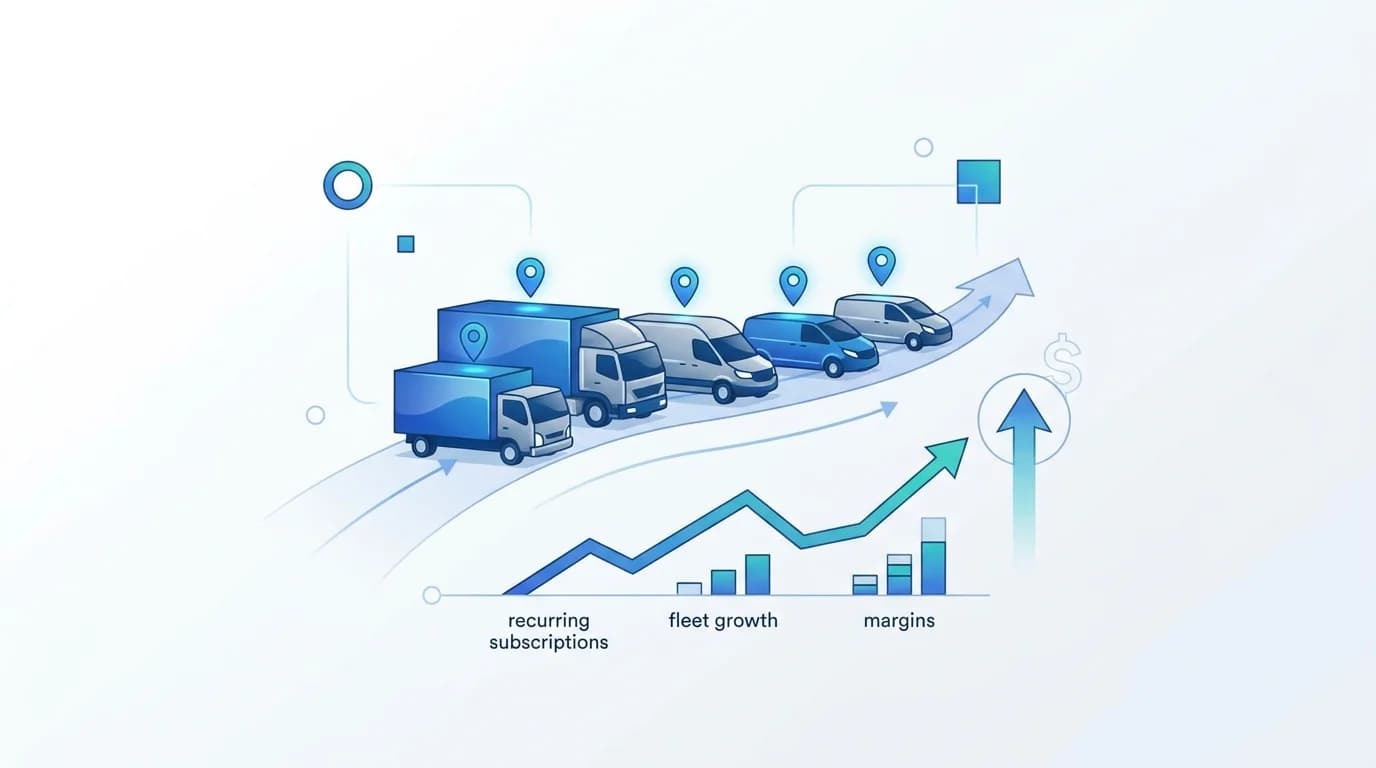
Yes, you can make money with a GPS tracking company, but only if it is profitable. The model works because the model has recurring revenue—you have a number of base vehicles that your customers pay you monthly for to track, and the more base vehicles you have and the more you get paid per month, the greater the revenue, the lower the fixed costs, and the better it is.
It depends on three factors: the margin you make on each vehicle (subscription price minus platform, SIM and support cost), customer churn and how far you are from break-even on fleet. This guide doesn't provide any universal profit number, since this depends on the operator, but it does provide the model that you can use to estimate yourself.
This article explains the recurring-revenue model, what a good margin per vehicle is, what makes or breaks it, the math behind profitability, and realistic expectations. It is about the profitability of owning a tracking business and not just the question of the savings for an end fleet from GPS tracking. See the startup cost breakdown for start up budgeting and how to start a GPS tracking reseller business for the business model.
Key Takeaways
- A GPS tracking enterprise generates ongoing per-vehicle subscription income, that also escalates with the number of base vehicles active.
- Profit is a function of margin per vehicle, churn and how much the fleet is above break-even — not on one industry metric.
- Recurring revenue is more important than hardware sales, since subscriptions will add up and hardware won't.
- The single largest structure risk to profit is a platform cost that goes up per vehicle, thereby limiting margin growth.
- The model compound is one that contributes to retention; changes of trackers on the fleet are disruptive; that is a friction which can help retention.
- Show profitability using your own price, cost and churn, not the margins you advertise.
Is a GPS Tracking Business Profitable?
A GPS tracking business can be profitable, and the reason is structural: it's a continuous service and not a one-time product which means that revenue will come in on a monthly basis until the customer cancels it. All tracked vehicles pay a monthly subscription fee, and as they are added to the system, the amount of subscriptions compounds over time, causing income to grow while the biggest expenses (infrastructure, staff, platform) remain pretty stable.
However, there is an active “can be” in that sentence. Profitability isn't the result of going to market, but depends on three factors: the margin you can enjoy on each vehicle, the number of customers you retain (churn), and if your fleet size is sufficient to cover your fixed costs. The model compounds get it right or they get it wrong — margins, churn, or fewer vehicles — and it takes a hit on sales regardless. The rest of this guide is dedicated to these levers.
How the Recurring-Revenue Model Works
Monthly recurring revenue (MRR): the amount of money generated by every active vehicle tracked by the business per month.The key to a GPS tracking business' success is monthly recurring revenue (MRR)—the total amount of money the business generates per month with each active vehicle tracked. MRR is ongoing income as customers keep coming and it decreases when customer churns, which is different from a hardware subscription, where they receive the income from the sale but it doesn't come again.
This is attractive because of the accumulation. The higher your vehicle sales are, the higher your MRR will go, with no need to resell the same customers. If you have several hundred cars, each of which will generate several hundred payments, then it makes sense that it will be disruptive to the customer to change trackers on each of those cars. And it could make it easier to keep the customer, and revenue, as well. The lesson to be learned: The business is retained subscription based so the number of active recurring vehicles is the number to watch rather than the number of total devices sold.
What Determines Your Margin Per Vehicle
Your margin per vehicle is the price you charge for the subscription minus the per-vehicle cost (the platform fee you pay to your provider, SIM/data & the cost of support you allocate to the vehicle). This contribution margin, times the number of vehicles in your fleet less your fixed costs, equals profit. The inputs are approximately as follows, assuming the use of 2026 third-party market reference ranges (from GPS providers, and comparison sites – illustrative only not Fleet Scanner pricing or quotes):
- Subscription price to your customer: typically $10-$50 per vehicle, per month, depending on the specifics of what you offer them.
- SIM/data cost to you: approximately $1-$3 per device/month.
- Platform cost to you: This depends on the provider and the model and is the one which will have the most impact on your margin, so this is up to you to confirm.
- Support cost: the staff time that can be attributed to a specific vehicle.
for your provider's per-vehicle pricing is based on the number of vehicles, it costs you more to add vehicles and it's not a great way to scale margins. As the platform is a fixed or licensed cost, your margin per vehicle increases with growth as the fixed cost is distributed over a larger number of vehicles. That's why the deployment and pricing model is the biggest and most impactful profitability decision – the startup cost guide and calculator illustrate how the per-vehicle versus fixed option affects the numbers.
The Break-Even Reality
Profitability begins when your fleet is big enough to pay your fixed monthly expenses, and this break-even can be a lot higher for new operators than they might think. The simple formula is:
The formula for calculating break-even vehicles is: Fixed monthly cost ÷ contribution margin per vehicle
The business is loss-making when the total number of vehicles is below the break-even point, because fixed costs (people, hosting, marketing) are much more significant at smaller fleet sizes. On top of that, every subsequent vehicle adds its full margin to profit, making the business grow quickly.
This is why many tracking business ventures suffer losses in the beginning – they must first cultivate the fleet before they can start making profits. It is also the reason why increasing price or reducing per-vehicle cost increases profitability more quickly than simply increasing the volume - it is because both increase the contribution margin that is divided by fixed costs, which reduces the break-even fleet size. The cost breakdownincludes a worked break even example and a calculator for modeling your break even.
What Makes a GPS Tracking Business More Profitable
This is a model of profit on four levers and the operators who do well pull all four:
- Higher margin per vehicle price for value delivered; and low cost per vehicle (platform, SIM, support). The best structural benefit is a platform cost that is independent of the number of cars.
- Low churn — Onboarding and support are the key factors and the natural turbulence as you move from one tracker to the next is a helping hand.
- Efficient customer acquisition — the lower the cost of acquiring each customer compared to what they are worth in the long term, the higher the profits will be. Focusing on a niche increases the possibility of reducing acquisition cost.
- Operational leverage As the fleet expands beyond break-even, the fixed costs are distributed among more vehicles and each new vehicle, therefore, makes greater profit. Scale is the key to supporting more vehicles for the same number of staff.
The repeated subscription is the fuel that makes it work, and there's additional fuel, profit, that comes from hardware margin, installation fees, premium tiers and paid integrations.
Realistic Expectations and Timeline
GPS tracking business is a business that goes slow, then compound, and not a business that's fast profit. Usually, you're in the red early on, with investment in hardware, setup and acquisition before revenue, profitability coming once the retained fleet hits break-even, after which MRR compounds. This will vary depending on your acquisition speed, price and cost structure so any specific time claim should be taken with a grain of salt.
Frequently Asked Questions About GPS Tracking Business Profitability
Is a GPS tracking business profitable?
It can be, since it generates subscription income per vehicle that increases as more vehicles are on the road and costs are relatively fixed. But it's not a foregone conclusion, as it will depend on the margin you make per vehicle, how many customers you lose, and if your fleet is profitable or not. No universal number, model it with your price and costs.
How do GPS tracking businesses make money?
Primarily by a recurring subscription or fee that is charged each month based on tracked vehicles, plus hardware margin, installation costs, premium levels and paid integrations. The core is the recurring subscription, as they grow as customers remain subscribed. A recurring subscription is the core, as it builds as customers remain subscribed, not just one-off device sales.
What is a good margin for a GPS tracking business?
Margin per-vehicle is not a specific percentage, it's your subscription price minus your platform, SIM, and support cost. “Good” is determined by whether it fits the bottom line of your fleet, and whether it sticks to that, or gets better, as you grow. The largest structural advantage is a platform that will not increase in cost per vehicle.
How many vehicles do I need to be profitable?
Your profit starts when your fleet is equal to your fixed monthly cost, which is determined by calculating Break-even vehicles = Fixed monthly cost ÷ contribution margin per vehicle. There isn't a standard number — it drops with increasing price and decreasing per-vehicle cost and increases with increasing fixed cost. Use the start-up cost calculator to build your own!
What is the biggest risk to profitability?
A per-vehicle cost of the platform that will limit margins as you expand and high churn that will prevent MRR from compounding. Both are addressable: Find a cost model that will not increase per vehicle and spend onboarding and support to retain customers. Low margins and high churn equals loss of money.
Is GPS tracking business profit the same as fleet ROI?
Profitability is what you make by running the GPS tracking service; No. Fleet ROI is what the end customer saves by employing GPS tracking. There are different questions — this guide is about the profit of the operator, not about the savings the customer gets.
Conclusion
Being profitable with your GPS tracking business depends on several factors aligning: having a strong margin with every vehicle, low churn, and generating a fleet with revenue above break-even -- with a business model that's recurring-revenue, which means it continues to grow as you go. Not quick and not a sure thing — early operators spend months below break-even as they grow the fleet — but it's a lasting one once the remaining fleet gets over the break-even point because subscriptions add up and fixed costs are distributed across more vehicles.
The most impactful decision you make for profitability is your cost structure; a platform fee that is not dependent on the number of vehicles will help to sustain your margin and enhance it with growth. Next steps: use the startup cost calculator to see how profitable you can be, learn about the platform model in white-label GPS tracking software, and book a walkthrough when it's time to compare a platform against your numbers.
Keep reading

GPS Tracking Hardware: How to Choose the Right Trackers
When selecting GPS tracking hardware, consider the type that is compatible with your tracking business and your customers' needs, determine if the trackers are compatible with the protocols of your platform (which helps prevent vendor lock-in), assess network capabilities for the areas you serve...
How to Price GPS Tracking Services: Formula & Pricing Tips
Track the price of a GPS system on a per-vehicle, per-month basis, and add your own per-vehicle cost (platform + SIM/data + support) plus your desired margin, and then select pricing model (flat, tiered, or hardware-bundled) based on the market you're operating in . There is no set price; the...

How to Start a GPS Tracking Business: 2026 Startup Guide
To get started in GPS tracking, you need to license a GPS tracking software platform that you can brand as your own, source compatible GPS hardware and SIM/data connectivity, set a recurrent per-vehicle subscription fee, and target a targeted customer base. The business has recurring monthly...