
Route Optimization Software: Cut Fuel Costs by 20%
The route optimization software determines the best way to sequence the stops and routes for a fleet's vehicles, taking into account traffic, delivery windows, vehicle size, driver hours, road restrictions, and more in one go. It's not navigation and this difference is significant: Navigation is to...
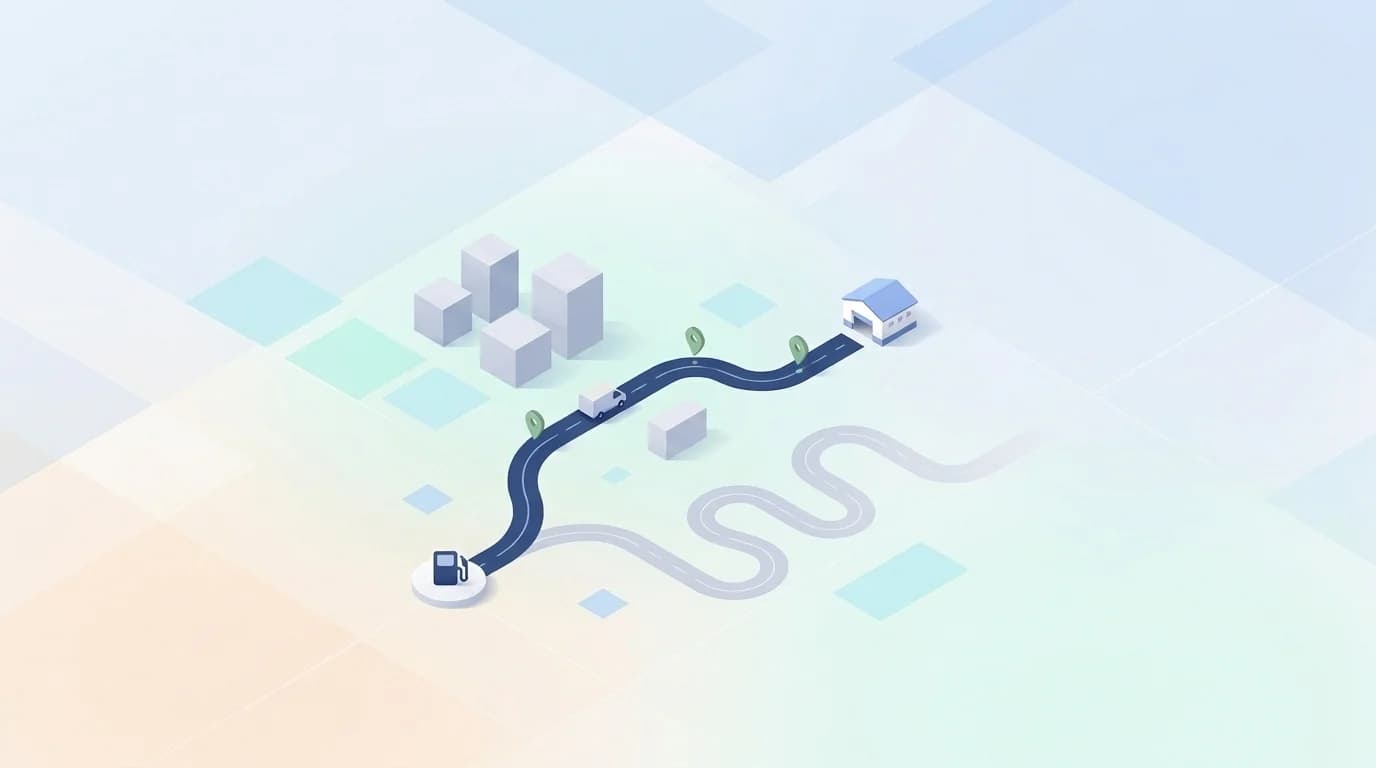
The route optimization software determines the best way to sequence the stops and routes for a fleet's vehicles, taking into account traffic, delivery windows, vehicle size, driver hours, road restrictions, and more in one go. It's not navigation and this difference is significant: Navigation is to find a way between two points, optimization is to solve a math problem that minimizes total miles and time over dozens of points and constraints. Fleet that converts from manual planning can expect to realize 12-20% reduction in total mileage within 90 days — and since each mile costs fuel, tyres and brakes, every mile saved is where the savings multiply.
Key takeaways
- Route optimization software is used to reduce overall mileage through multiple stops and restrictions; it is not used to answer a navigation question.
- Routes usually see a reduction in total mileage by 12-20% within 90 days, with AI routing potentially using up to 20% less fuel to save fuel costs.
- The savings don't just add up, fewer miles reduce fuel, tyres, brakes and maintenance costs.
- Dynamic routing optimizes throughout the day, whereas static (planned once) gets worse as things change.
- It's best when powered by live GPS and telematics data, meaning that routes will be based on where vehicles are, not this morning's route plan.
What is route optimization software?
Route optimization software is used to find the most efficient routes for a fleet of vehicles that have multiple stops. The software can consider numerous combinations of routes and deliver the sequence that will minimize miles and time while still meeting all constraints, rather than having a dispatcher manually sequence all drops or for drivers to run routes from memory.
That's the challenge: delivery time windows, vehicle capacity, driver hours of service, road and vehicle restrictions, and customer preferences all at once. A few of these can be balanced by a human for a couple of stops. Over dozens of vehicles and hundreds of stops, software is capable of analyzing all of these factors at fleet level at the same time, something that can't practically be matched by manual route planning, hence the trend toward route planning and trip operations
Route optimization vs navigation: the costly confusion
A common mistake fleets make is treating these as the same thing. They aren't.
| Term | What it does |
| Navigation | Find the best route between two points (A to B). One vehicle, one origin, one destination. |
| Route optimization | Finds the best sequence and paths across many stops, vehicles and constraints — a combinatorial problem. |
Navigation is about the question “how do I get there?” Operation researchers have been working for decades on the question of “what is the cheapest way to visit all of these and in what order – and in which car?”.” The difference between 5% and 20%+ on a fleet's mileage savings is determined by the algorithm quality. The key to not confusing the two is for fleets to purchase a mapping tool.
How route optimization software works
Modern route optimization is a process that is done in four steps and transforms orders into optimized routes on driver phones.
- Import stops and constraints. The software imports stops for the day from your order or dispatch system, time windows, vehicle capacities and driver availability.
- Optimise against live data. Algorithms are used to determine the lowest cost combination of routes for each vehicle based on traffic pattern data, the roads that are available and the actual (not estimated) distances.
- Dispatch to drivers. Optimised routes directly pass through to driver mobile apps which include turn by turn stops and ETAs, eliminating the need for manual re-keying.
- Re-optimise as the day changes. The software monitors live GPS tracking and traffic on dynamic systems and adjusts for delays, additional stops or if the driver is behind – ensuring that the plan remains valid rather than stale. How live data is transforming the industry.
Why live data changes everything
Real-time GPS and telematics data allows feeding optimization, as routes reflect where vehicles are and what traffic is really doing – and when routing and tracking are on the same platform, the same information is more readily available and there's less synchronising between different platforms.
The savings: what fewer miles actually cut
The savings are not just in fuel, but much more since every mile saved is one mile of deferred wear on the vehicle — the core mechanism is simple — fewer miles.
| 12–20%
fewer total miles within 90 days |
up to 20%
lower fuel bills with AI routing |
90–95%
on-time delivery vs ~75% manual |
The costs that drop when miles drop:
- Fuel — largest and quickest visible – shorter routes and less traffic idling burn less. Completely integrates with fuel monitoring.
- Maintenance and wear — every mile eliminated defers brake, tyre and engine wear. Less distance translates to less service events to plug into maintenance scheduling.
- Driver hours — reduced routes save labour hours and overtime.
- Missed-window penalties - delivery windows are missed regularly, avoiding SLA penalty clauses.
An illustrative example
The mileage savings for a 50-vehicle fleet are approximately 450,000 miles per year if the fleet's average mileage is 60,000 miles per vehicle and it lowers mileage by 15%. Using an illustrative variable operating cost of $0.55 per mile (not a universal measure which includes fuel, tyres, maintenance, etc.), it translates to approximately $247,500 annually, without taking into account recovered driver hours or improved on-time rates. It's about the method, not the number — try it using your own cpm.
Static vs dynamic routing
There are two ways, and it depends on the difference whether some of the savings will be preserved upon contact with a real day:
| Approach | What it does | Real-world result |
| Static routing | Plans routes once, up front, and runs them unchanged. | 10–12% savings — on a good day |
| Dynamic routing | Continuously re-optimises through the shift as conditions change. | Holds up when the day goes sideways |
Static routing is good, but only until it becomes obsolete because of some other change—traffic increases, a job is running overtime or a stop is added—and then this morning's routing is obsolete for the rest of the day. Dynamic systems can anticipate delays before they occur and reroute automatically, rebalance loads if a driver is behind schedule, and update customer ETAs automatically, without a dispatcher. Dynamic is the reliability of fleets that don't always follow their plans, which is — for most fleets — the norm. Fleet Scanner's Fleet AI Agent enables this type of real-time coordination.
Key features to look for
These are the features that distinguish actual route optimization from simply a glorified map when you're comparing route optimization software:
| Feature | What it does | Priority |
| Multi-stop optimization | Sequences many stops for lowest total miles | Essential |
| Constraint handling | Time windows, capacity, driver hours, restrictions | Essential |
| Live GPS / traffic data | Routes reflect real conditions, not estimates | Essential |
| Dynamic re-routing | Re-optimises mid-shift as things change | High |
| Driver mobile app | Routes and ETAs pushed to drivers directly | High |
| Customer ETA alerts | Automated SMS/email updates on arrival times | Useful |
| Telematics integration | Shares live data with tracking & maintenance | High |
How to choose route optimization software
A real buyer checklist in addition to the main features. Against your own operation, work through these; do not simply follow a vendor's list of features:
- Multi-stop and multi-vehicle optimization — can it optimize across your entire fleet at once, rather than one route at a time?
- Constraint support — can it support your true constraints such as time windows, vehicle capacity, driver hours, vehicle/road restrictions?
- Live GPS integration — does it use real time vehicle location or plan based on static maps?
- Dynamic rerouting — re-optimise in the middle of the shift, or is it plan-once-and-run?
- Driver mobile app — Do routes and ETAs make it to drivers without re-keying via mobile apps for drivers?
- Customer ETA notifications — If your customers expect them, Customer ETA notifications - automated, SMS/email arrival notifications.
- Telematics integration — is routing linked to tracking, fuel and maintenance?
- APIs and integrations — Is it suitable for your order, dispatch or ERP?
- Reporting — does it measure the mileage, fuel and on-time gains so you can prove ROI?
- Deployment and pricing model —SaaS vs self-hosted and its growth behavior (see below). SaaS route optimization vs self-hosted route optimization.
SaaS vs self-hosted route optimization
There are two deployment models for route optimization: It's a question of what's most important to you, and there isn't necessarily a single "best" solution.
| Factor | SaaS (cloud) | Self-hosted |
| Setup speed | Fast — running quickly | Slower — infrastructure to provision |
| Infrastructure | Vendor's responsibility | Yours to run and maintain |
| Data control | On vendor's cloud | On infrastructure you control |
| Pricing behaviour | Recurring, often per-vehicle | Licence/infra; can differ long-term |
| Best-fit | Speed and simplicity | Control and data ownership |
To summarise: SaaS normally values speed and simplicity, and self-hosted can offer greater infrastructure control and - based on licensing and operating costs - various long-term economics. It's the same “self-hosted vs cloud” fleet software deployment decision we discussed in our self-hosted vs cloud fleet management guide.
Who needs route optimization software?
Any fleet that has several stops a day per vehicle and manually plans routes. The more stops, vehicles and constraints, the more a human planner leaves on the table — the more, the better.
While delivery fleets are the obvious candidates, there are other types of fleets that can benefit even more, such as service fleets (HVAC, Plumbing, Pest Control, Field Maintenance, etc.), where skill-based technician assignment and variable job duration likely make manual planning even more lossy. If you have 5 vans or 500 trucks and if drivers are making a few stops and they are being hand or habit sequenced, then there is room for optimization. There is one thing to keep in mind: many manually planned routes deviate from the mathematical optimum because the driver likes to drive the route that he or she is used to.
Where Fleet Scanner fits
Route optimization is most powerful when it's based on the same real-time data as the rest of your fleet. Routes optimize on the same GPS tracking data that is used for dispatch and fewer miles go directly to fuel and maintenance savings because Fleet Scanner integrates route planning and trip operations into an all-in-one fleet platform. Self hosted with no fee per vehicle – optimisation is on your own connected data.
Want route optimization that runs on the same live data as your tracking and dispatch? Book a free demo →
Frequently asked questions
What is route optimization software?
Route optimization software uses algorithms to determine the best order of stops and routes for a fleet's vehicles, considering traffic, delivery windows, and vehicle capacity and driver hours at the same time. Unlike navigating from one location to another, it reduces total miles and time for numerous stops.
How does route optimization reduce fuel costs?
It saves fuel primarily by minimizing miles driven (stop sequencing optimizations, avoid wasted miles, avoid traffic idling). Fewer miles equals less fuel directly used, and with a reported fuel savings of 12-20% on the total mileage, that's a significant savings figure depending on where you drive, and the price of fuel.
How do I choose route optimization software?
Compare it to your operation, including multi-stop and multi-vehicle optimization, constraint handling (time windows, capacity, driver hours), live GPS integration, dynamic rerouting, a driver app, telematics and API integration, reporting and deployment model (SaaS vs self-hosted) and how it scales with your fleet size.
What's the difference between route optimization and navigation?
Navigation is used to determine the best route for one vehicle from one place to another. Route optimization is a combinatorial math problem that optimizes the sequence and routes for many stops, vehicles and constraints simultaneously. Navigation is about how you get there, optimization is about what is the most economical way to visit all of these in some order with one or more vehicles.
How much can route optimization software save?
Within 90 days, the total mileage of the fleet is reduced by 12–20%, and the fuel costs can be reduced by up to 20% with AI routing. The variable costs for a fleet of 50 vehicles can also be saved by hundreds of thousands of dollars a year when they decrease their mileage by 15% — this will depend on the fleet and route density.
What is the difference between static and dynamic routing?
Static routing is based on the assumption that it will always be the best route, and continues to use the same route even when it is not, with resulting mileage savings of approximately 10-12% on a good day, but suffering when road conditions change. Dynamic routing constantly optimizes through the change, adjusting to traffic, load balancing, and adjusting ETAs, so the savings remain in place when things don't go to plan during the day.
Does route optimization software need GPS tracking?
It is ideal for use with it. Live GPS and telematics data provide the ability for routes to be as dynamic as the vehicles themselves – and the traffic, as opposed to the static morning plans. Dynamic re-routing in particular requires real-time tracking and if routing and tracking are on the same platform, then there's less synchronization between two separate systems and that live data is more readily available.
Is route optimization software worth it for a small fleet?
Typically, if vehicles stop several times each day. The savings aren't just related to the number of vehicles in the fleet; the savings are proportional to stop density — meaning a few vehicles in the fleet making multiple stops each day means significant mileage is being left on the table when planned manually. Variable job times is where service fleets can reap the greatest rewards.
Keep reading
How To Reduce Fuel Costs With Fleet Software and Tracking
Fuel bills rarely jump because of one dramatic mistake. It’s usually death by a hundred small leaks: a truck idling behind a jobsite gate, a route that loops back across town at 4:30 p.m., a maintenance issue that quietly drags down MPG for weeks. If you want to reduce fuel costs without playing...
GPS Tracking Hardware: How to Choose the Right Trackers
When selecting GPS tracking hardware, consider the type that is compatible with your tracking business and your customers' needs, determine if the trackers are compatible with the protocols of your platform (which helps prevent vendor lock-in), assess network capabilities for the areas you serve...
How to Price GPS Tracking Services: Formula & Pricing Tips
Track the price of a GPS system on a per-vehicle, per-month basis, and add your own per-vehicle cost (platform + SIM/data + support) plus your desired margin, and then select pricing model (flat, tiered, or hardware-bundled) based on the market you're operating in . There is no set price; the...