
- Self-Hosted Software
Self Hosted GPS Tracking Software
Run self hosted GPS tracking software on your own server, not somebody else’s cloud. One-time license, unlimited vehicles, and no per-vehicle monthly fee to anybody. Your data stays in your database, your customers see your brand, and our team handles the install.
1,000+ tracker protocols · Ubuntu, Windows Server or any VPS · Live in 2 to 3 weeks
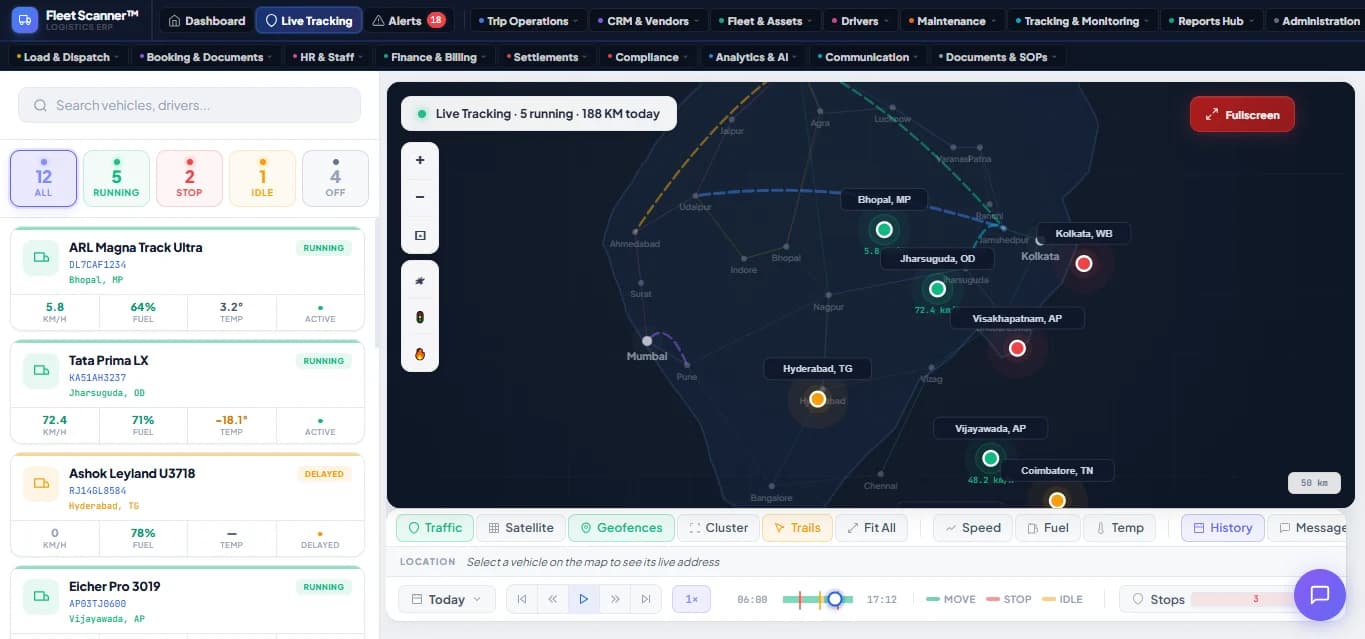
- Runs on your server or VPS
- One-time license
- Unlimited vehicles
- Full white-label
- You own the database
- 1,000+ tracker protocols
- Live GPS tracking
- Geofencing and alerts
- Fuel and driver monitoring
- Trips, maintenance and billing
- REST API and webhooks
- Android and iOS apps
- Fleet AI agent
- AIS-140 ready
- Install support included
Definition
What Is Self Hosted GPS Tracking Software?
Self hosted GPS tracking software is a vehicle tracking platform that runs on a server you own or rent, instead of on the software vendor's shared cloud. Your GPS trackers send data straight to your server. You hold the database, the user accounts, the branding and the backups. There is no per-vehicle monthly fee to a software vendor, and nobody else can switch your fleet off.
How Self Hosted GPS Tracking Works
A self-hosted setup changes one thing: where the tracker sends its data. That single change moves control of the whole system to you.
The tracker records
A GPS device in the vehicle reads location, speed, heading and ignition state every few seconds.
It sends to your IP
The device pushes those packets over 2G, 4G or NB-IoT to an IP address and port on your own server, not the vendor's.
Your server decodes
Fleet Scanner reads the raw packet, matches it to a vehicle, checks geofences and rules, then writes it to your database.
Your team sees it
The web dashboard and mobile apps read that database and show live positions, trips, alerts and reports.
Because every hop stays inside infrastructure you control, there is no third-party relay in the middle. That is the practical difference between self-hosted GPS tracking software and a cloud subscription. You can read more about the live map layer on the GPS and live tracking page.
Why It Matters
Why Businesses Move to Self Hosted GPS Tracking Software
Cloud platforms bill per vehicle, per month. Every truck you win makes that bill bigger. Self hosted GPS tracking software breaks that link: a one-time license on your own server, so growth stops being a cost problem.
Your cost stops growing with your fleet
A cloud platform at 300 rupees per vehicle per month costs 3.6 lakh a year on 100 vehicles, and double that on 200. A self-hosted license does not move. You pay for the server, and the server is cheap next to a per-unit bill.
You hold the data, not a vendor
Positions, trips, driver records and customer details live in a database you can query, export and back up yourself. That answers the data-residency question clients ask before they hand you their fleet.
It becomes your product
Your logo, your domain, your app name, your login screen. Customers never see Fleet Scanner. For a tracking company that is the difference between reselling and owning a brand.
No vendor can switch you off
Nobody raises your rate mid-contract, retires a feature you sold, or locks your export. If you ever move on, the server and the data are already yours.
You can change how it works
Custom reports, custom alert rules, custom workflows and direct database access. Connect it to your billing or ERP through the REST API and webhooks instead of waiting on a roadmap.
Fewer hops, faster updates
Trackers connect to your server directly. There is no shared queue in front of you and no noisy-neighbour slowdown when another customer floods the platform.
Requirements
What Do You Need to Run Self Hosted GPS Tracking Software?
Less than most people expect. Self hosted GPS tracking software runs comfortably on a single mid-size Linux server that handles thousands of trackers. Here is the sizing our deployment team uses as a starting point.
| Fleet size | vCPU | RAM | Storage | Typical setup |
|---|---|---|---|---|
| Up to 500 vehicles | 4 | 8 GB | 100 GB SSD | Single cloud VPS |
| 500 to 2,000 vehicles | 8 | 16 GB | 250 GB SSD | Dedicated server |
| 2,000 to 10,000 vehicles | 16 | 32 GB | 500 GB SSD | App and database split |
| 10,000 vehicles and above | 32+ | 64 GB+ | 1 TB+ SSD | Clustered deployment |
Ubuntu, Debian, CentOS or Windows Server
Your office server, a rented VPS, AWS, Azure or a private cloud
A static public IP and open TCP or UDP ports for your tracker protocols
None. Our team installs, configures and tests the platform for you
Sizing is indicative and depends on ping frequency, history retention and how many sensors each vehicle reports. Our team confirms exact specs before install.
Hardware
Which GPS Trackers Work With It?
Fleet Scanner supports more than 1,000 GPS device protocols, so you are not tied to one hardware supplier. Teltonika, Concox, Queclink, Ruptela, Jimi and most AIS-140 approved Indian trackers connect by pointing the device at your server IP and port. If a protocol is missing, our team adds it during setup.
This matters more than it sounds. Hardware prices move, suppliers run out of stock, and a client sometimes arrives with 200 trackers already fitted. Broad protocol support means you buy on price and availability rather than on what your software will accept. Fuel sensors, temperature probes, door sensors, CAN bus readers and dashcams feed into the same server. The full list is on the supported devices page.
Adding a device takes a minute: create the vehicle, paste the IMEI, choose the protocol, and configure the tracker to send to your IP. The unit appears on the live map as soon as the first packet lands.
Compare
Self Hosted vs Cloud SaaS vs Open Source GPS Tracking
All three put a vehicle on a map. They differ on who owns the data, who fixes it at 2am, and what the bill looks like in year three.
| Factor | Cloud SaaS (Wialon, Navixy) | Open source (Traccar, OpenGTS) | Fleet Scanner self-hosted |
|---|---|---|---|
| Where data lives | Vendor cloud | Your server | Your server |
| Software cost | Per vehicle, every month | Free | One-time license |
| Cost at 500 vehicles | Rises every month | Your developer time | Unchanged |
| Installation | Instant signup | You do it | Done for you |
| Support and SLA | Tiered, paid | Community forum | Named support team |
| White-label branding | Limited or extra cost | Build it yourself | Full, included |
| Beyond tracking | Add-on modules | Tracking only | Trips, fuel, maintenance, billing |
| India compliance | Rarely included | Not included | AIS-140, FASTag, GST, e-Way Bill |
| If you stop paying | Access ends | Keeps running | Keeps running |
Positions reflect the standard offering of each category in 2026. Vendor plans change, so check current terms before you decide.
Open source tools like Traccar are a fair starting point if you have a developer and only need dots on a map. What they do not ship is billing, maintenance history, driver settlement, GST invoicing or a support number. Those get built by you, and then maintained by you, forever. Fleet Scanner gives you the same server-level ownership with the operational modules already finished. Our fleet management platform page covers those modules in detail.
Licensing
How Self Hosted GPS Tracking Software Is Priced
One license for the deployment. Not one per vehicle, not one per user, not one per year.
What the license covers
The full platform on your server, unlimited vehicles and users, white-label branding, installation, configuration, device protocol setup and team training. Every module ships together, so nothing is held back behind a higher tier.
What you pay separately
Your server or VPS, and your SIM data plans. A VPS suitable for a few hundred vehicles costs less per month than a cloud platform charges for ten of them.
What happens when you grow
Nothing changes in the license. Adding 400 vehicles means adding 400 rows and, eventually, a bigger server. Your margin per vehicle improves as you scale instead of shrinking.
Updates and support
An optional annual plan covers version updates, security patches and priority support. If you skip it, your installation keeps running exactly as it is. It does not expire.
Inside the Platform
More Than a Map on Your Own Server
Most self hosted GPS tracking software stops at live location and a trip report. Fleet Scanner runs the rest of the operation on the same install, so fuel, drivers, service and invoices share one database.
Live tracking and geofences
Real-time position, speed, ignition and idle time, with route replay by date. Draw zones for depots, client sites and no-go areas and get entry, exit and dwell alerts. See geofencing.
Fuel monitoring
Fuel sensor readings, fill logs and sudden-drop alerts that flag theft the same day it happens. Consumption per vehicle and per route sits next to the trip that caused it. See fuel management.
Driver behaviour and payroll
Overspeed, harsh braking, cornering and night driving roll into a score per driver. Attendance and trip settlement use the same records. See driver management.
Maintenance and documents
Service due by odometer, engine hours or date. Insurance, fitness, permit and PUC expiry alerts before a vehicle becomes a fine. See maintenance.
Trips, billing and compliance
Trip costing, freight billing, LR and bilty, plus e-Way Bill and FASTag toll reconciliation for Indian operators who need it.
Reports and the AI agent
Sixty-plus reports you can schedule by email, plus an AI agent that answers plain questions like which vehicle is closest to its next service.
Switching
Moving From Your Current Tracking Platform
You do not have to touch the vehicles. Moving to self hosted GPS tracking software is a configuration change on the tracker, not a re-installation. The device is told to send to your server IP instead of the old one, usually by SMS command or over the air, and it reports to your platform from the next packet.
What usually worries people
- Sending technicians to every vehicle
- Losing years of trip and fuel history
- Days of downtime during the switch
- Retraining the whole dispatch team
- Buying new trackers
What actually happens
- Devices are repointed remotely, in batches
- Historical data is imported where the old platform allows export
- Both systems run side by side until you are ready
- Training is one session per team
- Existing hardware keeps working
We do this most often for companies leaving per-unit platforms such as Wialon, GPSGate or Navixy, and for teams who outgrew a Traccar install once clients started asking for invoices, maintenance history and proper reports. A pilot on 10 to 20 vehicles is the normal first step. Nothing is cut over until that pilot behaves.
Deployment
How to Get Your Own Tracking Server Running
Four steps. Most deployments go live within two to three weeks of the first call, and the technical work is ours, not yours.
Demo and sizing
A working walkthrough on live data, then we size the server against your vehicle count, ping rate and history needs.
Install on your server
We deploy to your machine, VPS or cloud account, secure it, fit your SSL certificate and open the tracker ports.
Brand and configure
Your logo, domain and app name go on. Vehicles, drivers, users, alert rules and report schedules are set up with you.
Connect devices and go live
Trackers are repointed to your IP in batches, the team is trained, and you run your own platform from that day.
Running It Safely
Who Looks After the Server?
The honest answer is that self hosted GPS tracking software moves some responsibility to you. Here is exactly how that responsibility is split, so there are no surprises after go-live.
Security on install
SSL, firewall rules, role-based user permissions and an audit trail of who changed what are configured before handover.
Backups
Scheduled database backups are set up during install. Because it is your server, you choose where copies are stored and how long they are kept.
Monitoring and updates
Uptime and disk alerts flag trouble early. Version updates and patches ship through the support plan and are applied at a time you pick.
Who Uses It
Who Self Hosted GPS Tracking Software Suits Best
Self-hosting pays off fastest for two groups: companies selling tracking to others, and fleets big enough that per-vehicle fees have become a line item somebody complains about.
GPS tracking companies and resellers
Stop paying a platform for every unit you sell. Run all your client fleets from one install, give each customer a branded portal, and keep the recurring revenue instead of passing most of it upstream.
Transport and logistics operators
Long-haul FTL and PTL fleets where trip costing, toll reconciliation and driver settlement matter as much as the live map. Everything sits in one database you own.
Manufacturers and distributors
Own vehicles and hired vendors on one screen, with maintenance planning that keeps the supply line moving and records that stay audit ready.
Construction, mining and rental fleets
Heavy machines, hired equipment and site vehicles with zone alerts the moment an asset leaves a permitted boundary, plus engine-hour based service.
Bus and passenger transport
School routes, staff shuttles and intercity coaches where route adherence, stop timing and parent or passenger visibility are the whole job.
Government and regulated operators
Contracts that require data to stay on approved infrastructure. Self-hosting answers that on paper, and the audit trail answers it in an inspection.
FAQ
Self Hosted GPS Tracking Software Questions
Straight answers on servers, licensing, hardware and switching from your current platform.
What is self hosted GPS tracking software?
Self hosted GPS tracking software is a vehicle tracking platform that runs on a server you own or rent, instead of on a vendor's shared cloud. Your GPS trackers send data straight to your server IP. You hold the database, the user accounts, the branding and the backups, and there is no per-vehicle monthly fee to a software vendor.
How does a self hosted GPS tracking server work?
The GPS device in the vehicle records location, speed and ignition state, then sends those packets over a mobile network to an IP address and port on your server. The software decodes the packet, matches it to a vehicle, checks geofences and alert rules, and writes it to your database. Your dashboard and mobile apps read from that database.
What server do I need to run GPS tracking software?
For up to 500 vehicles, a 4 vCPU server with 8 GB RAM and 100 GB SSD is a normal starting point. Between 500 and 2,000 vehicles, 8 vCPU and 16 GB RAM is typical. It runs on Ubuntu, Debian, CentOS or Windows Server, on your own machine, a rented VPS, AWS or Azure. You need a static public IP and open ports for your tracker protocols.
Is self hosted GPS tracking software cheaper than a cloud subscription?
It usually is once you pass roughly 100 vehicles. Cloud platforms charge per vehicle every month, so the bill grows with the fleet. A self-hosted license is paid once, and after that your only running cost is the server, which does not scale per vehicle. Below about 50 vehicles a cloud plan is often simpler.
Do I need a technical team to install it?
No. Our deployment team installs the platform on your server, secures it, fits the SSL certificate, opens the tracker ports and configures device protocols. Most deployments are live within two to three weeks of the first call, and your team is trained before handover.
Which GPS trackers work with Fleet Scanner?
Fleet Scanner supports more than 1,000 GPS device protocols, including Teltonika, Concox, Queclink, Ruptela, Jimi and most AIS-140 approved Indian trackers. Fuel sensors, temperature probes, door sensors and CAN bus readers are supported too. If a protocol is missing, our team adds it during setup.
Can I white-label the platform as my own product?
Yes. Your logo, domain, product name, login screen and mobile app branding replace ours completely. Each of your clients can also get their own branded portal to see only their vehicles, which is how tracking companies resell it as their own service.
How do I move from Traccar, Wialon or Navixy?
You do not touch the vehicles. Trackers are repointed to your new server IP remotely, usually by SMS command or over the air, in batches. Historical data is imported where the old platform allows an export, and both systems can run side by side until you are ready to cut over. Existing hardware keeps working.
Who owns the data in a self-hosted deployment?
You do. Positions, trips, fuel logs, driver records and customer details sit in a database on your infrastructure. You can query it, export it and back it up yourself. No third party can read it, throttle it or hold it during a contract dispute.
What happens if I stop paying for support?
Your installation keeps running. The license does not expire and the software does not phone home for permission. An optional annual plan covers version updates, security patches and priority support, but skipping it does not switch anything off.