
School Bus Safety Rules in India: 2026 Compliance Checklist
School bus safety rules in India explained: CBSE and NCPCR requirements, AIS-140 and GPS rules, driver and attendant checks, and a monthly audit checklist.
 Prerit Khera13 min read
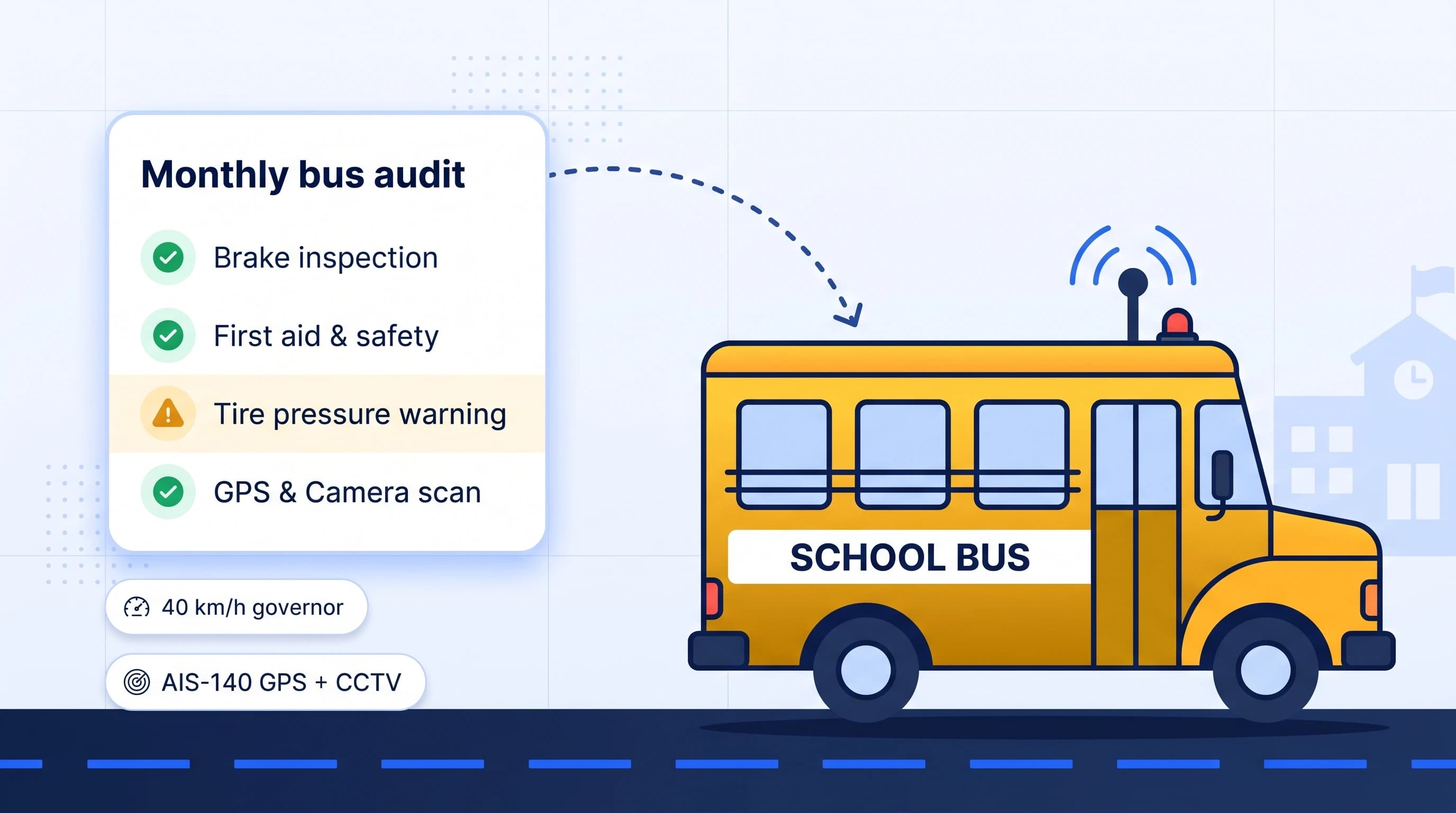
Direct answer: The CBSE affiliation directions, NCPCR school safety manual, Central Motor Vehicles Rules and State Transport Rules are the sources for School Bus Safety Rules in India. The specific ones that apply will depend on the school's board, legal classification of the bus, and the state that the bus operates in. The points listed below are organized into six main areas that can be audited monthly by the school.
Which School Bus Safety Rules Apply in India?
India does not have a standard checklist that applies to all school buses. The requirements may be dependent on the Board Affiliation of the school, legal classification of the vehicle, requirement of a permit and relevant state/ union territory (UT) transport regulations. Check all current circulars and permit requirements before considering any item on the checklist as a legal requirement.
Four kinds of rules overlap:
- CBSE (Central Board of Secondary Education) lay down the conditions to be fulfilled by the schools affiliated to it which include the condition of safety of transport in its affiliation Byelaw.
- NCPCR (National Commission for Protection of Child Rights), a statutory body for child rights, has released the Manual on Safety and Security of Children in Schools which schools are required to adhere to under CBSE.
- MoRTH (Ministry of Road Transport and Highways) in the Central Motor Vehicles Rules (CMVR), which includes tracking devices and fire safety systems.
- State transport departments issue permits and conduct fitness checks and may impose additional criteria.
| Source | Issued by, date | Applies to | Status |
| Circular 01/2012, Annexure IX of affiliation bye-laws | CBSE, 8 June 2012 | CBSE-affiliated schools | Requirement |
| "Safety of school children in the school bus" circular | CBSE, 2017 | CBSE-affiliated schools | Requirement; summary reported by PTI |
| Manual on Safety and Security of Children in Schools, item 15 | NCPCR, 2021 edition reviewed | Schools generally | Guidance; CBSE directs its schools to follow it |
| Circular 01/2022, "Safety of Children in Schools" | CBSE, 5 January 2022 | CBSE-affiliated schools | Requirement |
| Rule 125H, CMVR (G.S.R. 1095(E)) | MoRTH, 28 November 2016 | Public service vehicles, with exclusions | Law |
| Rule 125C, CMVR (G.S.R. 48(E)) | MoRTH, 27 January 2022 | School buses under AIS-063 manufactured from twelve months after commencement | Law |
| Permit and fitness conditions | State/UT transport departments | Varies | Law; check locally |
Sources: CBSE 2012, CBSE 2017 circulars list and PTI report, NCPCR manual, CBSE 2022, Rule 125H, G.S.R. 48(E). The Ministry of Education also circulated Guidelines on School Safety and Security to states and UTs on 1 October 2021 (Lok Sabha answer, 25 July 2022).
CBSE School Bus Guidelines: Key Requirements
The core bus requirements are specified in Annexure IX of the affiliation bye-laws (Circular 01/2012) for CBSE affiliated schools and GPS and CCTV were added to them in CBSE's 2017 school bus circular. The 2012 annexure includes a yellow bus with a label on it saying "School Bus" (or "On School Duty" if hired), window grills, locking doors, a speed governor set at 40 km per hour, a fire extinguisher, a first aid box, a driver with at least five years' experience heavy vehicle driving and clean challan record, an attendant, a teacher (or parent) on board, and a school transport in-charge CBSE 2012).
As per the report by PTI of CBSE guidelines, made GPS and CCTV compulsory, made them working at all times, made the school management and the head of school liable for lapses, and asked schools to appoint a well-trained lady attendant and a transport manager Business Standard)
NCPCR School Transport Safety Requirements
NCPCR's manual "Safety in School Transports" has identified six sets of measures including the bus exterior, fixtures, manpower, facilities, permits and school arrangements. CBSE list beyond this include conducting medical test for drivers annually (including an eye test), giving drivers refresher training at least twice a year, having a mobile phone on board for emergencies, no overtaking of other four-wheelers, periodic feedback on drivers and conductors to the students and keeping records (NCPCR manual, 2021, item 15). This article is a review of the 2021 edition, but NCPCR has updated its version dated 8 July 2026, which may be consulted if there are any changes.
School Bus Driver and Attendant Requirements
The CBSE and NCPCR have laid out the eligibility and staffing standards for school transport which are applicable to the schools themselves and their buses for safety of children and not for general driving licences.
| Requirement | Source and wording | Type |
| Licence and at least five years' heavy-vehicle driving experience | CBSE 2012; NCPCR item 15.E.I | CBSE requirement; NCPCR guidance |
| Not employed if challaned more than twice a year for specified violations, or once for over-speeding, dangerous driving or specified offences | CBSE 2012; NCPCR item 15.E.II–III | CBSE requirement; NCPCR guidance |
| Police verification of bus staff before appointment | NCPCR item 15.C.I | Guidance |
| Annual medical check including eye test | NCPCR item 15.C.V | Guidance |
| Qualified attendant, "preferably female" | NCPCR item 15.C.II; CBSE 2017 (PTI): "well-trained lady attendant" | Attendant expected; female preferred, not a universal legal mandate |
| At least one teacher on each bus | NCPCR item 15.C.IV | Guidance |
School Bus Equipment and Vehicle Requirements
Equipment requirements come from CBSE and NCPCR for school operations, and from MoRTH for the vehicle itself.
- Markings and fittings (CBSE, NCPCR): yellow body with the school name on it; "School Bus" on front and rear; "On School Duty" if hired; school phone number on display; horizontal grills and mesh windows; secure door locks; space for school bags.
- Speed control (CBSE, NCPCR): Slow speed governor/speed control device so that the bus does not go beyond 40 kms per hour. This is a school bus setting for this document, not a general speed limit on the road.
- Emergency equipment (CBSE, NCPCR): First aid box, Fire extinguisher and an alarm bell or Siren.
- Fire alarm and protection (MoRTH): The provisions of AIS-135 and AIS-063 have been merged in G.S.R. 48(E) 27 January 2022, which applies to school buses built to AIS-063 and manufactured after 12 months of the commencement of the rules. Look at the body code and manufacture date of your bus.
- Fitness and permit (state): fitness certificate valid and a permit as required.
Are GPS and CCTV Mandatory in School Buses?
Yes, for CBSE-affiliated schools: PTI reported that CBSE's school bus guidelines of 2017 had made GPS and CCTV mandatory for all schools, and they had to be in working condition all the time. Other schools might need GPS pursuant to rules and/or conditions, such as AIS-140 tracking for vehicles under the rule 125H. The manual of the NCPCR doesn't need GPS for the transport section.
Is AIS-140 Mandatory for School Buses?
It isn't ownership based but rather depends on the legal classification and permit status of the bus. According to (Rule 125H) of the CMVR, Public Service Vehicles (PSVs) must have a vehicle location tracking device and emergency buttons conforming to AIS-140, but the CMVR does not apply to two-wheelers, e-rickshaws, or three-wheelers for which no permit is required. AIS-140 is the Standard of the automotive industry for vehicle tracking devices and emergency buttons.
- A bus which has been hired under a contract of carriage permit is a public service vehicle and should generally be covered.
- Permit may or may not be required for an educational institution on bus (check with the state for requirements and conditions; consult the registration certificate and permit conditions).
- Some states have tracking requirements at permit/license renewal, please consult your state transport office regarding notification.
Read our IS-140 GPS tracker requirements: It covers the important features of a GPS tracker and how to verify its validation.
School Bus Safety Rules for Hired and Contractor-Operated Buses
The school's duty for safety does not transfer to the bus hire company when hiring a bus. CBSE has mandated hiring of buses with the label ‘On School Duty' and 2017 guidelines make the school management liable for lapses as reported by PTI. Include the checklist in the transport contract, ask for permits, fitness certificates, driver and staff records, GPS and CCTV records from the contractor, and do a bus audit as you would for your own buses.
Monthly School Transport Compliance Checklist
Run the audit of all buses, owned or hired, monthly in this table. The checks are a mixture of sourced and good operational practices; the "Basis" column indicates which is which.
| Check | Basis | Evidence to keep | Owner | If it fails |
| Markings, grills, door locks | CBSE, NCPCR | Dated photos | Transport manager | Fix before next trip; re-inspect |
| Speed governor set at 40 km/h | CBSE, NCPCR | Fitter's certificate; tracking speed report | Transport manager | Withdraw bus until fixed |
| First aid, extinguisher, alarm | CBSE, NCPCR | Expiry dates; photo | Attendant | Replace the same day |
| Fire alarm and protection system | MoRTH (by build date) | Manufacturer or fitness record | Transport manager | Raise with body builder or RTO |
| GPS and CCTV working | CBSE 2017; state rules | Last-reported times; sample footage | Transport manager | Repair; log the gap |
| Permit, fitness, insurance valid | State law | Copies with expiry dates | Transport manager | Stop use until renewed |
| Driver licence, experience, challans | CBSE, NCPCR | Driver file | HR / transport | Suspend from duty |
| Police verification, medical, training | NCPCR | Certificates and dates | HR / transport | Schedule; restrict duties |
| Attendant and teacher on board | CBSE, NCPCR | Duty roster | Principal's office | Fill the gap before the trip |
| Daily pre-trip and post-trip check | Good practice | Signed checklist | Driver and attendant | Escalate to transport manager |
| Student feedback on drivers | NCPCR | Feedback records | Transport manager | Review and act |
Make note of all findings with an owner and a due date, and re-inspect at the next audit. Talk repeated failures with the principal and/or, for hired buses, with the bus company in writing.
How GPS Tracking Helps Schools Monitor Transport Safety
GPS tracking can be used to support certain operational checks but it can't verify staff verification, medical fitness, equipment condition or provide complete legal compliance.
| Area | GPS can support | GPS cannot establish by itself |
| Speed | Recorded speed and over-speed events, subject to device accuracy and configuration | That a speed governor is certified, correctly installed or legally compliant |
| Routes and stops | Location history, stop duration, geofence events and route deviations | That every stop was safe or authorised, without context |
| Device operation | Last-report time and connectivity gaps, where supported | That CCTV or other safety equipment is working |
| Driver behaviour | Harsh braking and acceleration events, where supported | Driver identity or misconduct, without reliable identification and review |
| Parent communication | ETA or arrival alerts, if the feature exists | That a child boarded or was safely handed over, without a verified process |
See school bus GPS tracking for how it works. To get the platform view, check our school bus tracking system and GPS fleet management software.. Driver scores can be viewed and driver behaviour monitoring, can be added; permit and fitness expiry dates can be tracked with vehicle fitness and compliance reminders.
School Transport Monitoring with Fleet Scanner
School transport teams can track vehicles, check routes and stops, and get visibility of connected buses with Fleet Scanner. Teams can also review speed events, route deviations and vehicle connectivity via alerts and reports depending on the devices and features enabled. These records only assist with transport operations and internal audits, but are not a substitute for statutory documents, physical inspections, staff verification and school supervision. You can reach the Fleet Scanner team to verify device compatibility and features applicable to your fleet.
Frequently Asked Questions
What are the school bus safety rules in India?
They are from CBSE affiliation directions, the NCPCR school safety manual, Central Motor Vehicles Rules and state transport rules. Schools should check each source to see which ones apply, as this will be determined by the school's board, the classification of the bus, and if it requires a permit and its state.
Is GPS mandatory in school buses?
Yes for CBSE affiliated schools: CBSE 2017 School bus policy mandates GPS and CCTV which were to be always used. Other schools might need GPS because of state rules or permit conditions, such as AIS-140 tracking — as per rule 125H.
Is AIS-140 mandatory for school buses?
It will be only if the bus is in the jurisdiction of rule 125H. It applies to public service vehicles (PSVs), but not to transport vehicles which do not require a permit (such as hired buses on contract carriage permits depends on the registration and permit status and state rules); hired school owned buses on contract carriage permits are generally covered; school owned buses depends on the rules and registration.
What is the speed limit for school buses in India?
According to CBSE and NCPCR manual, school buses are to be fitted with a speed governor or speed control device to keep the bus speed restricted to 40kmph. That is only a requirement for school transport and not a general road speed limit.
What qualifications must a school bus driver have?
CBSE's bye-laws and NCPCR manual require a valid licence, 5 years experience driving heavy vehicles and a clean challan record. NCPCR further suggests that police verification of the appointments is required and the medical check-up be done annually which should also contain an eye check.
Is a female attendant compulsory on school buses?
The NCPCR manual has requested qualified attendant "preferably female" and the CBSE guidelines for 2017 had requested to designate qualified lady attendant in the schools. They expect an attendant; a woman attendant is a preference, not a legal requirement.
Are hired school buses subject to the same safety rules?
Yes. CBSE expects all buses to be hired to display ‘On School Duty’ and the guidelines issued in 2017 put the responsibility for any lapses on the management of the school. Contract schools should include safety provisions in their contracts and review buses as they do their own.
What fire safety equipment is required in school buses?
A fire extinguisher is required for CBSE and NCPCR. Since the commencement of school buses under MoRTH's G.S.R. 48(E) 2022, the school buses manufactured from 12 months after the commencement are required to have AIS-135 occupant-compartment fire protection provisions.
What records should a school keep for school transport?
Permits, fitness certificate and insurance; driver licence, experience and challan history; police verification and medical history; equipment expiry dates; GPS and CCTV checks; student feedback; monthly audit logs with actions taken.
Primary sources and review details
The CBSE has issued Circular No. 01/2012 dated 8th June 2012 under Annexure IX (transport safety) of the circular regarding affiliation byelaws cbse.gov.in
Summary reported by PTI in Business Standard, 24 February 2017; CBSE, 2017 circular "Safety of school children in the school bus" on CBSE's 2017 circulars page – cbse.gov.in;
The Manual on Safety and Security of Schools, 2021, Item 15 (Safety in School Transports), NCPCR – ncpcr.gov.in
The CBSE has released the "Safety of Children in Schools" Circular No. 01/2022, dated 5 January 2022 — cbse.gov.in
MoRTH, G.S.R. 1095(E), 28 November 2016, rule 125H of the CMVR — notification PDF
The Central Motor Vehicles (First Amendment) Rules, 2022 issued by the MoRTH, G.S.R. 48(E), dated 27 January 2022, including the Gazette copy
Lok Sabha Unstarred Question No. 1170, Ministry of Education, on School Safety and Security guidelines, dated 1st October 2021, available on eparlib.nic.in
Keep reading

Motive Alternatives: 6 Fleet Tools Compared for 2026
Motive (formerly KeepTruckin) is strong on US ELD compliance and AI dashcams, but it is not the right fit for every fleet. Here are six alternatives to Motive and how to pick one.
6 Webfleet Alternatives for 2026: Honest Comparison
Six real Webfleet alternatives compared on hosting, hardware, EU tachograph tools and pricing, plus when staying with Webfleet makes more sense.
FASTag Management Software for Fleets: How to Choose
FASTag management software explained for fleets: how toll reconciliation works, the features to compare, what it costs and what to test in a vendor demo.