Skip to content
Fleet Scanner
Hardware integration · Teltonika FMB900

Teltonika FMB900 GPS tracker, set up in Fleet Scanner

The Teltonika FMB900 is a cheap, compact 2G tracker for basic vehicle tracking. Teltonika first launched it in 2018. It is small, has Bluetooth, and hides its GPS and mobile antennas inside the case. A small backup battery keeps it going for a while if the power is cut. Point it at your own Fleet Scanner server and its data turns into a live map, alerts, driver scores and reports. The blocks below show what the FMB900 sends and what you can do with it.

2G GSM 850/900/1800/19001 · 1 · 1 DIN · DOUT · AINBLE 4.0 EYE sensors + OBD donglePort 11922
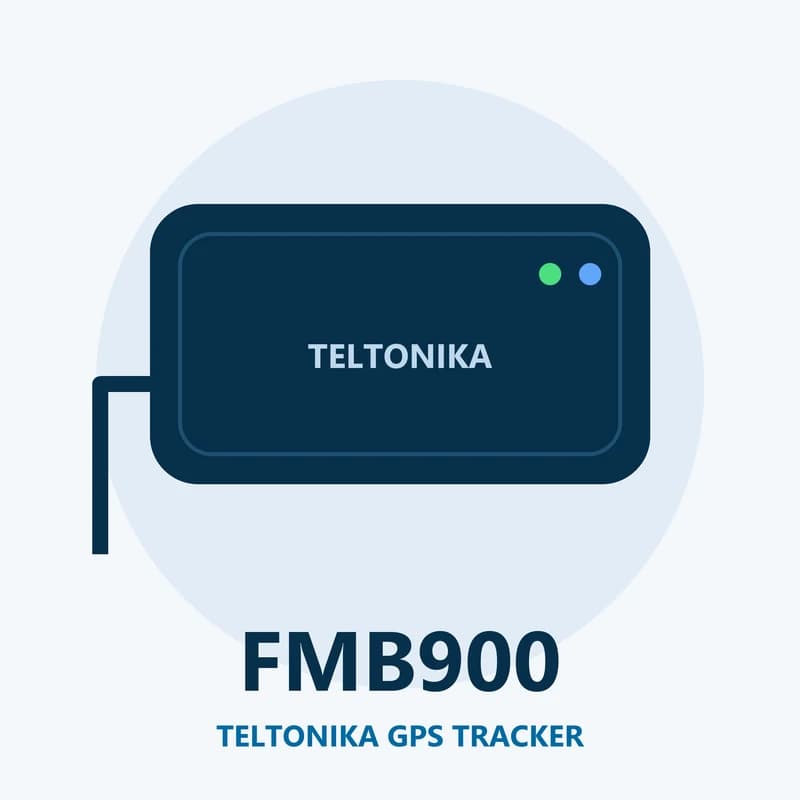
Illustration of the Teltonika FMB900 GPS tracker
4satellite systems (GPS, GLONASS, Galileo, BeiDou)
33GNSS receiver channels
422,400records kept in 128 MB flash
170 mAhbackup battery
< 3 mposition accuracy
live_position
Speed 47 km/hIgnition ONMoving
01 · Live tracking · Permanent I/O

Where every car is right now, and how fast it is going

The FMB900 listens to four satellite systems at once: GPS, GLONASS, Galileo and BeiDou. Its 33 channel receiver finds its place again in under a second after a short stop. Each record carries the position, speed and ignition state. Fleet Scanner draws the car on the live map and saves the whole route. Later you can replay any day, stop by stop.

Position Speed Ignition Movement Odometer
GPS fleet tracking software →
eco_driving · accelerometerX -612Y 180Z 990
Harsh accelerationScore -3 pts
02 · Driving behaviour · Scenarios

Eco driving, speeding and long idle stops

A motion sensor (accelerometer) sits inside the FMB900. The Eco and Green Driving scenarios use it, or GPS, to spot hard speed ups, hard stops and sharp turns. You choose the limits yourself. Over Speeding starts when the car goes a little over your speed limit. Excessive Idling fires when the car stands still too long. Fleet Scanner adds each event to the driver’s score, so you know who needs a quiet word.

Harsh acceleration Harsh braking Harsh cornering Over speeding Excessive idling
Driver scorecards →
security · alarms
Crash DETECTEDBackup ON
03 · Theft and tamper alerts · Scenarios

Alerts for a crash, a tow truck or a blocked signal

The FMB900 watches its motion sensor for sudden hits on each side, which can mean a crash. With the ignition off, it can tell if the car is lifted or pulled away by a tow truck. It also notices jamming, which is when someone blocks the mobile or GPS signal. Unplug detection tells you when the tracker loses its power wires. Fleet Scanner pushes every one of these to your phone as an alert.

Crash detection Crash trace Towing Jamming Unplug
Real-time fleet alerts →
digital_io · in / outDIN1 Ignition ONAIN1 12.4 VDOUT1 Relay OFF
DIN1 ONDOUT1 OFF
04 · Inputs and outputs · Permanent I/O

One wire for ignition, one for a sensor, one to stop the engine

The FMB900 has five wires: power, ground, one digital input, one analog input and one digital output. The digital input is meant for the ignition wire. The analog input reads 0 to 30 V, so it can take an analog fuel sensor. Put a relay on the output and you can stop a stolen car from starting. A relay is just a switch that cuts the engine circuit. With DOUT Control Via Call, a call from a trusted phone number can turn the output on too.

Digital input 1 (ignition) Analog input 1 Digital output 1 DOUT control via call
Vehicle and equipment protection →
obd · bluetooth dongle
OBD PAIREDSpeed 47 km/h
05 · Engine and OBD data · OBD-II via BLE

Car data from a Bluetooth OBD-II plug

The OBD-II port is the car’s diagnostic socket, usually under the dashboard. Plug a Bluetooth OBD-II dongle into it and pair the dongle with the FMB900. The tracker then gets data from the car itself, with no extra wires. It can even use the car’s own speed from the dongle to decide if the car is moving. Fleet Scanner keeps that data next to the trip, which helps with service plans.

OBD-II speed Engine data from dongle Movement from OBD speed
Preventive maintenance scheduling →
fuel · gnss counter
Tank 71 %Drop -12 L
06 · Fuel monitoring · LLS + OBD

Fuel use from the trip, a tank sensor or the car

There are three ways to get fuel data from the FMB900. The GNSS Fuel Counter works it out from your own fuel norms for city, average and highway speeds. An analog level sensor (LLS) on the analog input shows how much is in the tank. A Bluetooth OBD-II dongle can add fuel data from the car. Fleet Scanner puts it all on one fuel chart, so a refill or a theft stands out.

GNSS fuel counter Analog fuel level (LLS) OBD-II fuel data
Fuel monitoring system →
ble_sensors · EYE
BLE temp 5.2 °C1 sensor
07 · BLE sensors · Bluetooth 4.0 + LE

Bluetooth sensors, beacons and a barcode scanner

The FMB900 speaks Bluetooth 4.0 + LE. Teltonika lists EYE beacons and EYE sensors, a headset, an OBD-II dongle and an Inateck barcode scanner as add-ons. It can also pair with Teltonika TZ-BT04 and TZ-BT05 temperature sensors and Efento sensors. Fleet Scanner keeps each reading with the time and place. That way a delivery van can prove its load stayed cold.

EYE sensor EYE beacon BLE temperature Barcode scanner
Speeding, idling and geofence alerts →
geofence · trip
Zone Yard 2Left zone
08 · Geofences and trips · Scenarios

Parked car zones, your own areas and trip logs

When the engine stops, Auto Geofence draws a small zone around the parked car and warns you if it leaves. Manual geofences are areas you set, such as a yard or a client’s gate. The Trip feature logs where each trip starts and ends, from engine on to engine off. In Fleet Scanner you can draw as many extra zones as you need. Every trip is saved and can be replayed.

Auto geofence Manual geofence Trip start / stop
Fleet geofencing software →
device_health · power12.6V
Ext 12.3 VGSM 3/5
09 · Power and diagnostics · Permanent I/O

Car battery, backup battery and signal at a glance

The FMB900 runs on 6 to 30 V, so it fits both 12 V cars and 24 V trucks. It reports the car’s voltage, its own backup battery and the mobile signal. Sleep modes cut its power use while the car is parked. Fleet Scanner checks these values on every record. A weak car battery or a lost tracker shows up as an alert, not as a silent gap on the map.

External voltage Backup battery GSM signal Sleep mode
Fleet reports and dashboards →

FMB900 specifications

Network2G GSM quad-band 850/900/1800/1900 MHz, GPRS class 12
GNSSGPS, GLONASS, Galileo, BeiDou, SBAS, QZSS, DGPS, AGPS; 33 channels
Accuracy< 3 m; hot start < 1 s, cold start < 35 s
Power supply6 to 30 V DC with overvoltage protection
Backup battery170 mAh rechargeable
Inputs / outputs1 digital input (ignition), 1 analog input (0 to 30 V), 1 open collector digital output
InterfacesBluetooth 4.0 + LE, USB, internal high gain GNSS and GSM antennas, built-in accelerometer
Memory128 MB internal flash (about 422,400 records)
Size79 x 43 x 12 mm
CertificationsCE/RED, UKCA, E-Mark, EAC, RoHS, REACH
Fleet Scanner port11922 (TCP)

Specifications can differ between hardware revisions. Check the manufacturer’s datasheet for your exact unit.

How to connect the FMB900 to Fleet Scanner

  1. Mount the FMB900 out of sight under the dashboard. Wire VCC to 6 to 30 V power, GND to ground and DIN1 to the ignition wire. Add a relay on DOUT1 only if you want to block the engine.
  2. Open the Teltonika Configurator on a Windows PC over USB, or over Bluetooth by picking the device named FMB900 plus the last 7 digits of its IMEI. You can also use SMS commands. Enter your SIM’s APN.
  3. Under GPRS settings, type your Fleet Scanner server’s domain or IP, set port 11922 and choose TCP. Save the settings to the tracker.
  4. In Fleet Scanner, add the FMB900 by its IMEI and link it to a vehicle and driver. Pair any OBD-II dongle or EYE sensor, then drive around the block and check the live map.

Teltonika FMB900 FAQ

Can I use the Teltonika FMB900 with Fleet Scanner?

Yes. Set it to send to your Fleet Scanner server on port 11922 over TCP. You then get its location, ignition, input and output states, eco driving events, crash, towing, jamming and unplug alerts, and data from paired Bluetooth sensors or an OBD-II dongle.

Is the Teltonika FMB900 end of life?

We found no end of life notice for the FMB900 from Teltonika. It is still listed with Teltonika’s basic trackers, and Teltonika put new base firmware (04.00.00) on it in July 2025. If that changes, Fleet Scanner keeps working with the units you already have.

How is the FMB900 different from the FMB920?

Teltonika sells the FMB900 as its low-cost compact 2G model for basic tracking, and the two share one user manual. Both have the same five wires: power, ground, DIN1, AIN1 and DOUT1. Both use Bluetooth 4.0 + LE. Fleet Scanner treats them the same way on the same port.

Does the FMB900 work on 4G networks?

No. The FMB900 only uses 2G (GSM/GPRS). If your country is closing its 2G network, pick a 4G Teltonika tracker such as the FMC920 instead. Fleet Scanner supports it as well.

Can the FMB900 stop a stolen car from starting?

Yes, once a relay is wired to its digital output. An approved user in Fleet Scanner can then switch the relay and block the starter. Only do this when the car is parked and it is safe.

Your FMB900 trackers, on your own server.

From a single tracker to a mixed fleet across 1,000+ device models: live tracking, alerts, fuel, drivers, maintenance and reports in one self-hosted platform. See it with your own hardware.

Get a free demo

More supported GPS trackers

Data names follow Teltonika’s FMB900 manual. Some depend on add-ons (OBD-II dongle, BLE sensors). Teltonika and FMB900 are trademarks of Teltonika Telematics. Specifications from the Teltonika FMB900 datasheet, quick manual and wiki.

Take Control with
Fleet Tracking

Track vehicles in real time, optimize routes, and take full control of your fleet operations.

Free Demo