
Fleet Workforce Management: Drivers, Shifts & Payroll
Learn how fleet workforce management connects driver scheduling, GPS attendance, shift planning, payroll, trip-based payments, and expense tracking.
 Prerit Khera12 min read
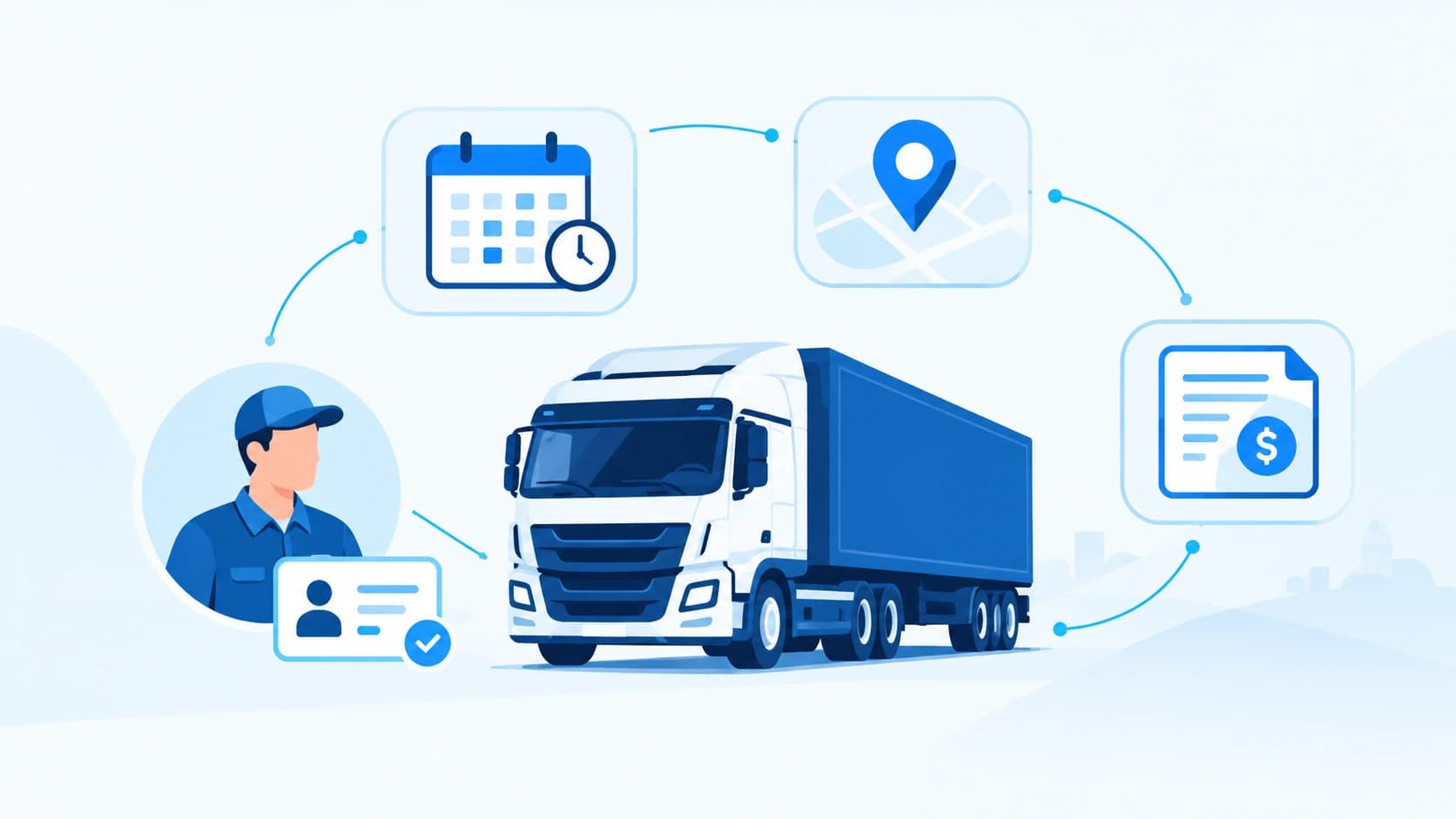
Direct answer: Fleet workforce management refers to how a transport company plans, records and pays its workforce, particularly its drivers, but also its helpers and supervisors. It connects four processes: duty planning on a roster, gathering evidence of what occurred based on attendance and trip and/or GPS tracking, reviewing and approving exemptions, and calculating pay and settling advances. GPS data is very valuable in establishing evidence of vehicle time, but it cannot replace driver's input and supervisor's approval since it does not show every minute a driver is on the job or resting. Pay rules and legal limits are suitable based on your contracts and the operating area.
At a Glance
| Question | Quick answer |
| What is fleet workforce management? | Planning, recording and paying drivers, who are the principal people driving your vehicles, from one connected record. |
| What does it cover? | Records of driver's licence, driver's record, attendance time, duty time, shift rosters, trip-based pay, advances, and incentives and deductions. |
| What is the workflow? | Roster plan to attendance and trip/gps evidence to exception review/approval to payroll and settlement. |
| How are drivers usually paid? | In part – often mixed – this is a combination of fixed pay plus trip pay or kilometer pay, allowances and incentives, minus advances recovered and authorized deductions |
| Is GPS data enough for pay? | No. It indicates vehicle activity, loading/ waiting/ paperwork and breaks require driver input and supervisor approval. |
| What rules apply? | Working-hour, overtime and wage-payment law varies between countries and, in India, worker category and state. |
What Is Fleet Workforce Management Software?
Fleet workforce management software is a system that stores driver logs, schedules duty, logs attendance and calculates trip earnings all in a single location. It responds to three questions that are very practical: what kind of drivers are permitted to drive which cars today, who actually worked and for how long, and what is due to each of them.
It's an extension of driver management software,, typically concerned with driving behaviour and safety scores, but includes the time and money dimension: rosters, attendance, duty time, settlements and payroll. The boundary is drawn in a different way by vendors. Motive says its workforce management product is "one place for worker records, qualification documents and timecards, and payroll integrations (Motive Help Center).
The difference about fleet payroll is that pay is sometimes tied to trips. A warehouse worker typically gets paid for hours at work while a truck driver can get paid by days on duty, trips, kilometres driven, nights away and performance. This is the reason why fleet payroll is best when it is based on trips and GPS records and not registers.
Why Driver Workforce Management Matters
Paying errors and dropping the wrong roster is more expensive than it is to replace a driver. The IRU survey of road transport operators in Europe, Australia, Brazil, China, Mexico and Uzbekistan in 2025 revealed that the number of unfilled drivers was between 10 and 15 per cent, with Europe showing an average of 502,000 (IRU report preview, 2026). It is not an India-specific measure and should be viewed as a global context.
- Cost control: driver pay, allowances and overtime should be linked to each trip - cost control.
- Safety: rosters that fail to allow for rest will keep worn down drivers on the road.
- Compliance: working hours, overtime and payment of wages are controlled, and records are what you present to an inspector.
- Trust and retention: A driver able to view how pay was calculated will be less likely to challenge the pay or walk away.
How to Manage Driver Records and Licence Expiry
Maintain one record of drivers per driver containing identity and licence and documents, the type of vehicles they are approved to drive, their pay structure and their trip, attendance and payment history.
- Licence and documents: Remind of licence class and expiry; badges; medical and/or police documents; reminders before expiry. See fleet compliance and document tracking.
- Qualifications: The types of vehicles, routes or loads to which a driver is authorized to drive, for example, vehicles for transporting hazardous goods, vehicles for transporting passengers.
- Pay structure: fixed pay, trip or kilometer rates, allowances, incentive rules and any authorized deductions – once it is not remembered.
- Performance: number of trips completed, on time delivery, fuel efficiency and safety score. Driver scorecards Describe how the scores are constructed and RAG thresholds describe how to fairly band the scores.
This record is used for all subsequent steps. A roaster should not have a driver with an expired licence and a rate should not be paid for a driver that has not been recorded.
How to Schedule Driver Shifts and Manage Rest Periods
First create the roster from the work and then create the named driver roster, taking into consideration rest periods, night work and cover drivers.
- Start from the work. For each day, list the trips, routes, or shifts which are required to be covered by the driver, the starting time, and the duration. Your load and dispatch plan is provided as input.
- Apply the limits. Implement daily and weekly duty periods, rest between duty, weekly duty days off and duty break rules for your drivers and your contracts (see the next section).
- Assign drivers. Assignment of appropriate qualified drivers to duties, allocation of night runs, and long hauls on a fair basis.
- Plan cover. Be sure to have spare drivers, or a standby list for absenteeism, breakdowns and peak days, otherwise you risk another driver having to work for the "long boy.
- Compare plan with actual. Perform weekly duty checks by referring to approved duty records. Do not stretch a route by overruns, change the plan, and don't change the driver.
The shift patterns vary depending on the operation. Long-haul trucking can have a two-driver crew, city delivery and bus operations frequently have fixed daily shifts, employee transport brings in night drops and pick-up windows. In all cases, the roster is a plan. It does not become a record until it has been read over and the evidence of attendance and trips has been reviewed.
How GPS-Based Driver Attendance and Duty Tracking Works
Duty is checked against real activity by combining app check in and out (with stamp of time and location), with trip and vehicle events.
| Record | What it shows | What it can miss |
| Roster | Planned duty and who was assigned | What actually happened |
| App check-in/out | When the driver says duty started and ended, with location | Forgotten or late check-ins |
| Trip and GPS events | When and how far the vehicle moved; ignition and stops | Loading, waiting, paperwork, off-vehicle work, breaks |
| Driver notes and supervisor approval | Corrections and context for exceptions | Nothing, if reviewed promptly |
Duty time does not equal driving time. The driver may be on duty loading or waiting at a gate or finishing paperwork, and with the engine off. Track gaps and overruns with GPS tracking, allow drivers to add notes and have it authorized by a supervisor before it gets to payroll. Late starts, breaches of check-out or duty of exceeding your duty level, etc., can trigger fleet alerts for review.
How to Calculate Fleet Driver Payroll: Formula and Example
The vast majority of fleets pay a fixed fee, a trip or distance-based fee, include allowances and incentives and deduct the amount of advances recovered and other deductions permitted by law.
Driver pay = Fixed pay + Trip or kilometre pay + Allowances and incentives + Overtime − Advances recovered and authorised deductions.
Comparing fixed salary, per-trip, per-kilometre and hybrid pay
| Pay model | How it works | Suits | Watch out for |
| Fixed salary | Monthly or daily rate for days on duty | Fixed routes, buses, staff transport | Little link to productivity |
| Per trip | Set amount per completed trip or route | Repeat routes of similar length | Unfair when trips vary widely |
| Per kilometre | Rate per km from GPS or odometer | Long-haul trucking | Waiting and loading time unpaid |
| Hybrid | Fixed base plus trip or km pay and incentives | Most mixed operations | Needs clear, written rules |
A hypothetical monthly settlement
Hypothetical figures are for illustration only, not a pay recommendation nor a pay result of a Fleet Scanner customer. A driver on a hybrid structure with a long-haul license has the following month, each of which is from a different record:
| Item | Source record | Amount (₹) |
| Fixed pay | Pay structure in the driver record | 15,000 |
| Trip allowance: 22 approved days away × ₹300 | Trip records, after exception review | 6,600 |
| Kilometre incentive: 6,000 km × ₹0.50 | GPS distance for completed trips | 3,000 |
| Safety bonus | Driver scorecard rule | 1,000 |
| Gross pay | 25,600 | |
| Wage advance recovered | Advance log, under an authorised deduction | − 5,000 |
| Amount after advance recovery | 20,600 |
Gross pay is 15,000 + 6,600 + 3,000 + 1,000 = ₹25,600, and the amount after recovering the advance is 25,600 − 5,000 = ₹20,600. It is not the driver's final net pay; the example does not take into account any income tax, any statutory contributions that may apply (such as provident fund or employees' state insurance), and any other items as may be applicable which will depend on the driver, the employer and existing legislation. Overtime hours not worked.
Advances, expenses and deductions
Ensure that wage advances are not used to pay for trips, but that all others are paid against records, and that only what is legally allowed is recovered from wages. Trip float for fuel, tolls, and food is money on hand for the business: reconcile with bills and approved expenses when the trip ends. When an employee is paid early this is called a wage advance and will be deducted from their payroll.
Which Workforce Metrics Should You Track?
Track a small set of measures that show whether pay is accurate and on time, duty is within limits, and drivers stay.
- Pay accuracy: Disputes / corrections per Pay Run.
- Timeliness: The number of days between the end of the period and payment.
- Duty and rest: drivers who are not adhering to planned duty, and rest that has been gained between duties.
- Exceptions: Unapproved attendance exception at pay run cut-off.
- Advance balance: exceptional advances in trip and wages per driver at the end of the month.
- Retention: Drivers who have left over a quarter and their reasons.
The fleet management KPIs guide guide helps set baselines, and fleet reports combine attendance, settlements and safety scores for each driver.
How to Choose Fleet Workforce Management Software
Select software that only maintains one driver record and creates approved duty and trip information that you can explain as pay.
- One driver record shared by the roster, attendance and payroll.
- GPS-stamped attendance checkable against trips, with a way for drivers to add notes.
- An approval step for exceptions prior to payroll.
- Configurable pay rules for fixed, per-trip, per-km and slab incentives.
- Advance and expense tracking associated with trips, separation of trip floats and wage advances.
- Document expiry alert for licences, badges and medicals.
- A clear driver payroll report and exports for your accounting or statutory payroll system.
The 25-feature fleet software checklist covers the wider platform.
Frequently Asked Questions
What is fleet workforce management?
It is the process by which a transport business plans, logs and pays the individual employees that operate the vehicles in that business. It includes driver records and documents, shift rosters, attendance and duty time, and trip-based pay – ideally all one connected record, thus eliminating the need to re-enter the same data three times.
How should truck drivers be paid: per trip, per km or salary?
There is no one right model. Fixed pay is paid for regular journeys, per-trip pay is paid for repeat journeys of a similar length and per-kilometre pay is paid for long haul journeys. A lot of fleets employ a combination of a fixed salary plus a trip or km pay and incentives, all of which are spelled out explicitly.
How do you schedule driver shifts to avoid fatigue?
Create rosters based on: work/limits of duty, weekly duty and rest, then assign drivers. Rotate night and long haul duty fairly, hold cover drivers for absenteeism and match scheduled duty and approved duty records weekly.
How does GPS-based driver attendance work?
Drivers log in and out of the system via a mobile app, and the time and location are recorded. Trip and vehicle events along with displaying when the vehicle was operating. Any gaps or driver notes are checked by supervisors before using for pay.
How does GPS support driver payments?
Rules based on distance, trip or allowance require GPS data of distance, trip completion and vehicle activity; GPS provides these. It is evidence — not the whole record: Waiting, loading and off-vehicle work requires driver input/approval before pay is calculated.
What is the difference between duty time and driving time?
Driving time is the time spent by the driver when he/she is operating the moving vehicle and duty time also includes loading, waiting, paperwork and other work. In India, the hours of work are defined as running time, subsidiary work and short time at terminals for motor transport workers.
What should a driver payroll report include?
It should reflect individual components of the pay and the basis for each, such as, fixed pay, duty days, trips, kilometres, allowances, incentives, overtime etc., and should also include recovered advances and other deductions. Highlighting the origin of each line will enable drivers and supervisors to verify the figure.
How are driver advances reconciled?
Document advances as a trip advance or wage advance. Close the trip with matching trip floats with bills and approved expenses; recover wage advances as allowed by law and limits of wage deductions by payroll only.
Is fleet workforce software the same as HR payroll software?
Not usually. Fleet workforce tools analyze operational data to determine trip-based pay, duty days, advances and incentives. Payroll and tax and benefits filing could be integrated into a stand-alone HR or accounting system, so make sure to understand how the two tie up.
Fleet Workforce Management with Fleet Scanner
Fleet Scanner is a GPS tracking and fleet management system. Its driver management module tracks attendance with GPS-stamped mobile app check-in and out, and driver settlements from trip records, attendance data, and advance logs, includes custom payment method options, and allows for tracking advances and loans. Its fleet ERP automatically calculates duty days from actual trips, and works out per-km, per-trip or slab incentives – per cycle – and reconciles trip operations between driver advances and actual costs.
Compare these against your own pay rules and legal requirements, and pilot one branch before switching. For the wider picture, see the fleet management software guide.
Keep reading
FASTag Management Software for Fleets: How to Choose
FASTag management software explained for fleets: how toll reconciliation works, the features to compare, what it costs and what to test in a vendor demo.

Preventive vs Reactive Fleet Maintenance: Which Costs Less?
Preventive maintenance services vehicles on a plan; reactive maintenance fixes them after they break. Here is what each really costs and how to switch to a planned schedule.
Best CRM for Fleet Management Companies
Compare the best CRM for fleet management companies in 2026. Explore fleet CRM features, leading platforms, and how to choose the right solution.