
Machine Learning in Fleet Management: Real Use Cases (2026)
Machine learning in fleet management improves predictive maintenance, route optimization, driver safety, anomaly detection, and fuel forecasting in 2026.
 Prerit Khera13 min read
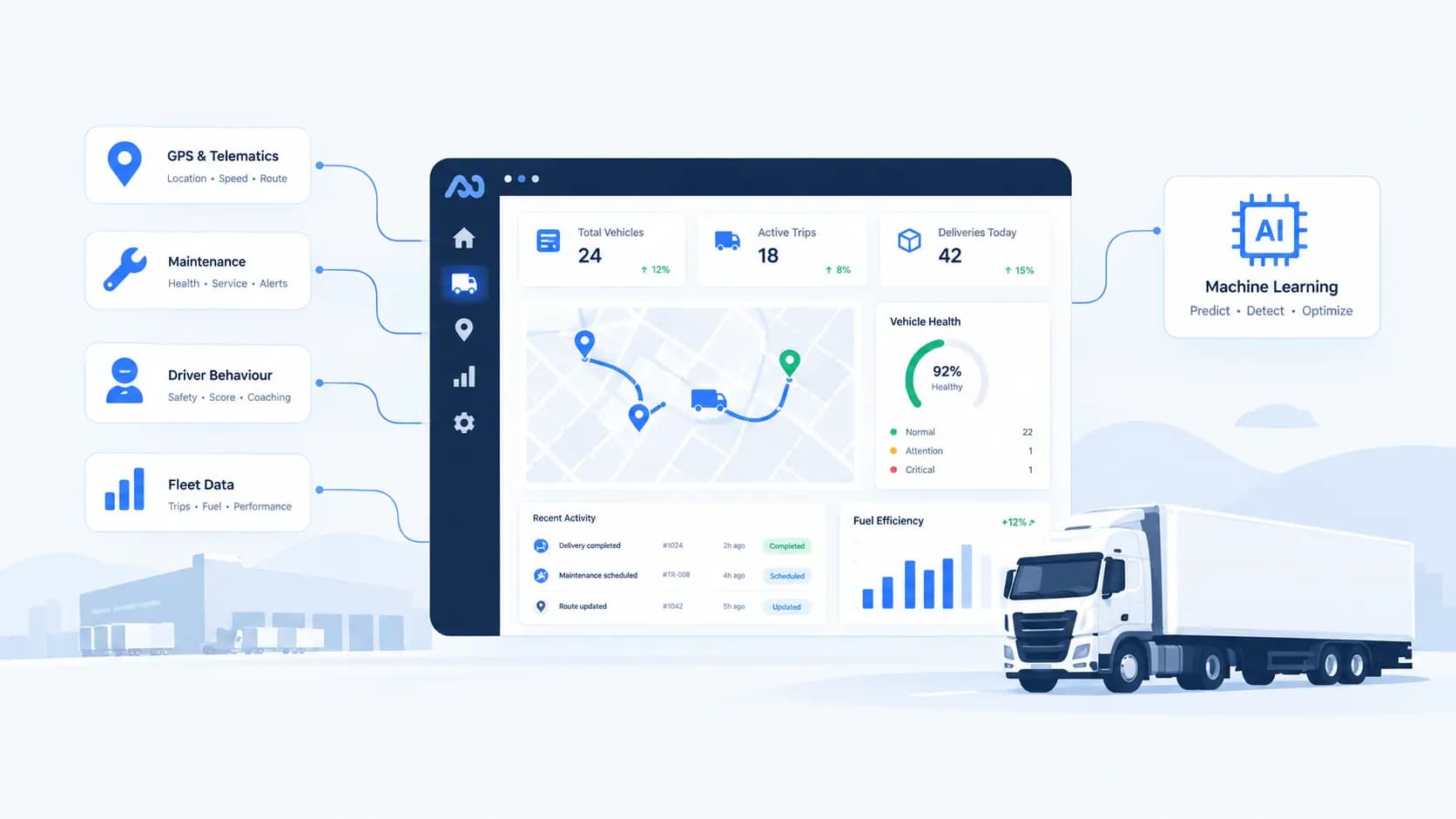
Fleet management machine learning, as it's explained in six real use cases — the machine learning technique used in each case and a realistic assessment of the evidence, separating what works in the real world of AI in fleet management from the marketing noise.
THE SHORT ANSWER
Machine learning (ML) in the context of fleet management involves training a machine on the existing data that the fleet produces—GPS data, engine sensors, driver behaviour, trips and more—that can predict and alert on items that a person would miss.
Real-life use cases — predictive maintenance, route optimization, driver-behaviour and safety scoring, anomaly detection, demand and fuel forecasting, computer-vision dashcams — really are being put to the test in 2026.
“AI in fleet management” is not a product and “ML” is not a feature — it’s a collection of techniques to solve specific problems, each with a different model, data needs and maturity. The six AI fleet management use cases are covered in turn, examining what they do, the technique that underlies them and what the evidence actually shows, followed by limits and how to adopt each use case.
AI, machine learning & telematics: what's different
In fleet marketing, the terms “AI in fleet management,” “machine learning,” and “telematics” are frequently used as synonyms for each other, but they are not identical and the difference is important when considering a product.
Telematics is data collection, and the GPS unit and sensors that share information on where the vehicle is, how fast it's travelling, and what the engine is doing. It gathers, it does not predict.
Machine learning is a collection of techniques that discover patterns in that information and forecast from those patterns: which component is most likely to malfunction; which path is the quickest; which driver is becoming more aggressive. The more the ML model observes the more it will improve.
Artificial intelligence (AI) For fleet software, it's generally ML plus some automation as a layer on top, typically in the form of turning a prediction into an alert, or a route change, or a report.
So telematics is the raw material, ML is the engine that makes it foresight and “AI” is the label it ships under. One platform can have good telematics and no real ML and another can add a chatbot to it and say it has AI. The key question with any vendor that claims to offer “AI-powered” is: which model, trained on what data, making what decisions? This guide is organized around that question.
How ML learns from fleet data
Each of the use cases listed below is executed on the same basic pipeline. Knowing it allows you to have a more tangible guide and, most importantly, why data quality, not the algorithm, is typically the determining factor for whether or not ML is successful for a fleet.
Collect. Data per vehicle is generated continuously from telematics units, OBD/engine sensors, dashcams, fuel records and trip logs. Extra feeds (traffic and weather) are introduced.
Clean & label.Deduplication of raw signals, handling of gaps, and attaching historical outcomes — this vibration pattern led to a bearing failure. This is where most projects work out or fall apart.
Train. A model is trained with the past relationship between the inputs and the outcome, on months or years of history.
Predict. The trained model scores real-time data, including failure probability, ETA, a risk score, and an anomaly flag.
Act. As the prediction is used – a maintenance ticket, re-route, coaching alert, a flag on a dashboard – the output is used to retrain the model.
Modeling is usually the easiest part of fleet ML. It's bringing clean, consistent, well-labelled data out of a mix of hardware, years of history. A simple model based on a good set of data wins nearly all of the time compared to a sophisticated model based on a messy set of data.
The six real use cases
Below are the cards for each of the use cases, along with the ML technique employed, and the evidence — including sources and vendor or survey figures appropriately labeled.
01 Predictive maintenance
The most ripe use case. Rather than waiting for a vehicle to break down and have service performed, ML determines when a vehicle's components are likely to fail based on sensor data, such as engine temperature, vibration, oil pressure, brake wear, and other such information, and schedules service just before the component is about to fail. This results in reduced numbers of roadside breakdowns and over-servicing.
ML TECHNIQUE
Supervised classification & regression; Random Forests, Gradient Boosting, Anomaly detection for time series sensor data.
Result
Based on vendor case studies, over 90% of failures were accurately predicted within 14 days and downtime was significantly reduced.
02 Route optimization
Static routing software has been around for years, while the ML-based software will learn from a fleet's own travel experience and adjust on the fly. Models evaluate traffic, weather and delivery windows, vehicle capacity and driver hours to schedule stops and reroute incidents, across the entire fleet, and not just one vehicle at a time.
ML TECHNIQUE
Optimisation algorithms, plus predictive models of travel time; increasingly, reinforcement learning for multi-stop, multi-vehicle sequencing
Result
The study by MIT has shown that route optimization algorithm can reduce fuel consumption by ~18% and CO₂ emission by ~25% Routes are crucial in determining gains, also baseline.
03 Driver-behaviour & safety scoring
Telematics records aggressive braking, fast acceleration, cornering, speeding and idling. But rather than treating drivers the same, ML transforms raw events into a per-driver risk score and identifies any trends of fatigue or distraction.
ML TECHNIQUE
Event data classification and clustering; pattern recognition to distinguish the real risk from noisy one-off events.
Result
AI has enhanced driver-safety outcomes, according to 56% of the 1,800 Fleet managers surveyed by Webfleet.
04 Anomaly detection
Anomaly detection isn't used to predict a failure; instead, it learns the normal conditions for each vehicle and reports when the conditions are not normal, for example, a drop in fuel, a leak, an engine reading outside of normal parameters for that truck. It's how a fleet is keeping an eye on thousands of vehicles without human eyes reading through each gauge.
ML TECHNIQUE
Baseline modelling unsupervised anomaly detection; baseline modelling by asset then deviation scoring. No need for failed cases to be labelled.
Result
A good example is showing when published case studies describe refrigerated fleets finding early leaks within days of the start of the leak. As a fleet gets larger, so does their impact.
05 Demand & fuel forecasting
ML predicts what to expect: When will demand be high, or low – adjust fleet size accordingly; how much fuel will be used by route and style of driving – plan accordingly; when will the vehicle be down – plan spare capacity accordingly. These are planning tools: they move decisions from “reactive” to “scheduled.”
ML TECHNIQUE
Forecasting (and regression) of historical demand, fuel and utilization data incorporating external seasonality indicators.
Result
Cost reduction was named as the No. 1 fleet benefit of investing in AI (Webfleet: 52%) . The accuracy of forecasts is influenced by the depth of history and the level of demand stability.
06 Computer-vision dashcams
AI dashcams process real-time camera footage with computer vision algorithms to identify distracted and drowsy driving, tailgating, and road hazards, and alert the driver in-cab and save video footage for incident analysis and insurance. This is the use case that is most apparent to drivers.
ML TECHNIQUE
Object and event detection using computer vision (deep neural networks), typically operates at the edge (on-device) for low latency.
Result
According to a vendor report, dashcams are responsible for a 73% increase in driver safety and a 48% decrease in accident costs (ATS) in the Fleet Technology Trends 2024 report.
Use cases compared: technique, data & maturity
A side-by-side read. Not a vendor claim, “maturity” is our editorial review of the level of proven and widespread adoption of each use case in 2026. The outcomes figures are approximate and taken from the cards above - check the named source before using.
USE CASE | CORE ML TECHNIQUE | DATA IT NEEDS | MATURITY |
Predictive maintenance | Classification / regression on time-series | Engine & sensor history + labelled failures | Proven |
Route optimization | Optimization + travel-time prediction | Trip history, traffic, weather | Proven |
Driver-behaviour scoring | Classification / clustering | Telematics event data | Proven |
Anomaly detection | Unsupervised anomaly detection | Per-vehicle baselines (no labels) | Maturing |
Demand & fuel forecasting | Time-series forecasting | Historical demand, fuel, utilization | Maturing |
Computer-vision dashcams | Computer vision (deep learning) | Labelled video / camera feed | Proven |
Data > model
Regardless of the algorithm used by the vendor, the key to choosing the best solution is whether your fleet has an adequate amount of clean, consistent, well-labeled history to train algorithms. Determine the data requirements prior to the features.
What ML can't do yet
If you're honest, you'll state the boundaries. What ML in fleet management doesn't consistently provide in 2026, according to a demo.
It won't fix bad data. These are what any model can do at best: mixed hardware, missing readings and inconsistent logging. Data issues, not model issues, are the most disappointing for ML deployments.
It doesn't predict the truly novel. Predicting the variability of what a model has seen in the past is a model trained in your history. If a failure mode or demand shock occurs for the first time in data, it will not be captured.
Accuracy figures don't transfer A 90% accurate result on one fleet, route, and climate doesn't necessarily apply to your fleet, route, and climate. Use vendor numbers as a starting point for piloting; don't assume they are a promise.
Full autonomy is not here for most fleets. The prediction and alert use-cases above would be the more day-to-day value in 2026, while the self-driving trucks are the news.
It raises real privacy and compliance questions. The legal and human resource considerations of driver-facing cameras and location data are different from one area to another, and should be addressed for BEFORE implementation, NOT after.
How to adopt ML in a fleet
A series of practical steps that will not lead to the purchase of an “AI platform” before the data is ready to be put into it.
Start with one problem, not a platform.Choose the use case that's most clearly costed, typically predictive maintenance or driver safety, and has a measurable baseline to benchmark.
Audit your data first. See what data your telematics collects, how uniform it is across the fleet and how many historical data you're storing. This determines what's possible.
Run a time-boxed pilot.According to published benchmarks, ROI is likely to be evident on fleets of about 25+ vehicles, and pilots can run for a few weeks with full rollouts a few months [verify]. Base your measurement on a baseline, not the vendor's.
Keep a human in the loop. Predictions should be used to prioritize a decision, not leave it now unattended, until the model is trusted on your data.
Plan the integration. So, if the output of the ML isn't delivered to a dispatcher, a tech, or a driver's tool, it's useless. (Internal References: GPS tracking, telematics data & APIs, driver safety.)
See ML working on your own fleet data
Fleet Scanner is an all-in-one fleet management platform that transforms your vehicles' GPS, trip and sensor data into predictive maintenance, driver-safety insights and real-time tracking with your customers and billing. The genuine test comes when you undertake a pilot on your fleet, against a baseline.
Explore Fleet Scanner → fleetscanner.io
Frequently asked questions about Machine Learning in Fleet Management
What is machine learning in fleet management?
It's the application of models based on the data of a fleet itself, GPS, engine sensors, driver behavior, trip history, etc., to predict and flag what people would not otherwise notice. Predictive maintenance, route optimization, driver-behavior scoring, anomaly detection, demand and fuel forecasting, and computer-vision dashcams are all main working use cases in 2026. It is a collection of techniques used on the problems, not a feature.
What's the difference between AI, machine learning, and telematics?
The data collection is what's called telematics, the GPS and the sensors reporting what each vehicle is doing. The set of methods which discover patterns in that information and make predictions are called machine learning. The umbrella term is AI, which typically refers to ML and automated follow-up, an alert or action based on a prediction. A big part of what ML is doing is serving as the engine for telematics, and AI is the label for the product it ships under.
What is AI in fleet management?
AI in fleet is the umbrella term for a range of software that leverage machine learning and automation to make fleet decisions based on data, such as predicting maintenance, optimizing routing, scoring driver safety, identifying anomalies, and forecasting demand. In real-world applications, AI fleet management almost always involves machine learning models trained on telematics information and sensor data, which generates an alert, a rerouting or a report. It's a toolkit of applied techniques, not one feature, so the actual question is: What is it doing, on what data, with which model.
Which ML use case should a fleet start with?
Either predictive maintenance or driver-behaviour safety, as both are most easily measurable and have a clear cost to improve, and are both highly proven. Aim to solve one problem and set up a starting point to measure, not sign up for a “AI platform” before your data is ready to be used with it.
Does machine learning in fleets actually save money?
It can reduce costs, in some specific ways — fewer breakdowns, less over-servicing, lower fuel use, safer driving — and surveys regularly list cost reduction as the primary benefits fleets gain from adopting it. Published percentages are typically from other fleets or from vendors, and do not automatically apply. The only way to know your return is through a time-boxed pilot with a return to your own baseline.
What data do you need for fleet machine learning?
Data uniformity throughout the fleet, sufficient data to indicate some sort of pattern (months to years), and records of previous failures to learn from (for predictive maintenance). In the area of computer vision, there are use cases that require camera feeds. Prior to committing, data quality and consistency are more important than the algorithm used for all use cases.
Is machine learning the same as self-driving trucks?
No, the future application of ML is not autonomous driving, but that's where fleets find value today as well. In 2026, all of this becomes useful — prediction and alerting; maintenance, routing, safety, anomalies, forecasting; — and the human element will still make the final call. Don't view full autonomy as something that you're going to implement in your use cases today, but as a longer-term progression.
Glossary & sources
Terms used above, defined plainly.
Supervised learning
Training a model on labelled examples (inputs and known outcomes), e.g. labelled sensor readings and the subsequent failures.
Anomaly detection
Knowing what is normal for an asset and identifying deviations – not having to have examples of each problem labelled.
Computer vision
Machine Learning used to understand images or video, e.g. Detection of events such as distraction or tailgating in a dashcam.
Time-series forecasting
Forecasting values (demand, fuel, downtime) from a series of values recorded over time.
Reinforcement learning
A model that learns through trial and feedback, a subject that is getting much research attention for multi-stop multi-vehicle route sequencing.
Telematics
The hardware and software of the GPS and sensors which collect and transmit vehicle information, the input ML is processed.
Keep reading

Route Optimization Software: Cut Fuel Costs by 20%
The route optimization software determines the best way to sequence the stops and routes for a fleet's vehicles, taking into account traffic, delivery windows, vehicle size, driver hours, road restrictions, and more in one go.
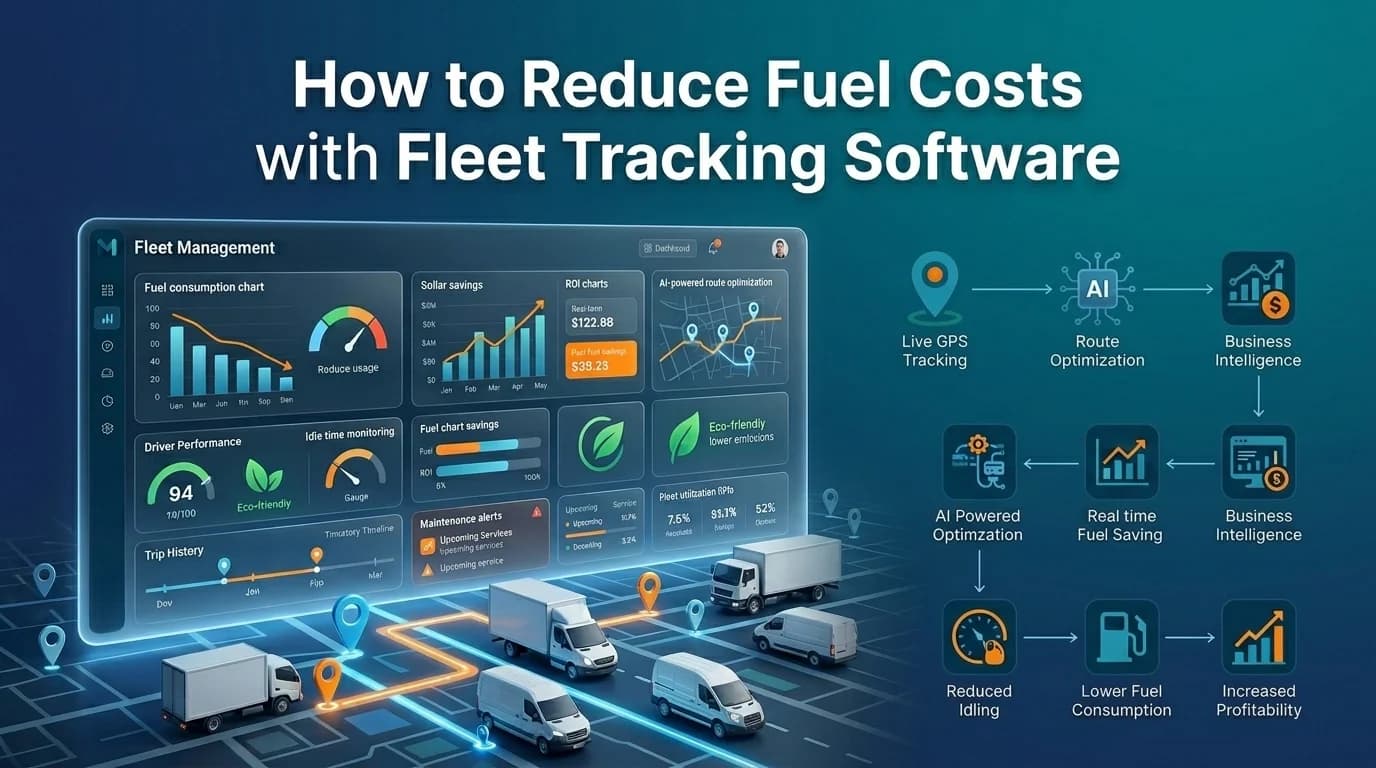
How to Reduce Fuel Costs with Fleet Tracking Software
Reduce Fuel Costs with Fleet Tracking Software Fuel is the largest expense that most fleets can't manage. Or so it seems. Fuel costs go up, cars idle and bills keep increasing. However, a significant portion of fuel cost is money that can be saved.
Cut Fuel Costs and Downtime With Fleet Software: A 30-Day Plan
Fuel bills rarely jump because of one dramatic mistake. It’s usually death by a hundred small leaks: a truck idling behind a jobsite gate, a route that loops back across town at 4:30 p.m., a maintenance issue that quietly drags down MPG for weeks. Here is how fleet software cuts fuel costs and downtime, with a 30-day plan to start.