Skip to content
Fleet Scanner
Hardware integration · Teltonika FMB150

Teltonika FMB150 CAN bus tracker, set up in Fleet Scanner

The Teltonika FMB150 is a 2G GPS tracker with a CAN data chip inside the same small case. CAN bus is the wiring that a car or truck uses to share its own data. So the FMB150 can send the real fuel level, engine speed and mileage along with its position. Fleet Scanner takes those records and shows them as live tracking, fuel graphs, driver logs and alerts.

2 CAN lines read by the built-in chip3 · 2 · 2 DIN · DOUT · AIN1-Wire driver keys + temperature2G quad-band GSM
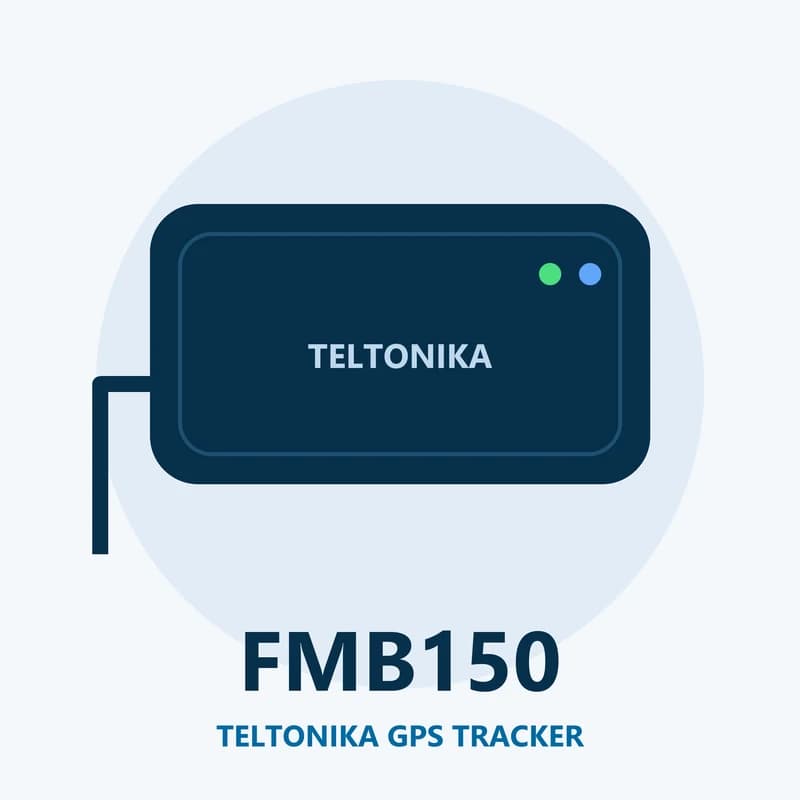
Illustration of the Teltonika FMB150 GPS tracker
2CAN interfaces
500iButton keys on the allowed list
128 MBflash memory for records
170 mAhLi-Ion backup battery
< 3 mGNSS accuracy
live_position · gnss
Speed 71 km/hIgnition ONParked NO
01 · Live tracking · Permanent I/O

Where each vehicle is, and if the engine is running

The FMB150 uses GPS, GLONASS, Galileo and BeiDou, plus AGPS for a quicker first fix. Each record carries the place, the speed, the ignition state and a moving or parked flag. Fleet Scanner draws the route on the live map as it happens. Later you can replay any day and see where the vehicle stopped.

239 Ignition240 Movement16 Total odometer
GPS fleet tracking software →
can_bus · built-in chip
RPM 1,560Pedal 32 %
02 · FMB150 CAN bus data · LV-CAN200 / ALL-CAN300 mode

Fuel, RPM and distance read off the CAN bus

Two CAN lines go into a chip built into the tracker, so no extra adapter box is needed. In the Configurator you set the LVCAN mode to auto detect, LV-CAN200 or ALL-CAN300. The chip then reads values such as fuel level, total fuel used, wheel speed, distance driven, engine RPM and how far the accelerator pedal is pressed. Fleet Scanner keeps each value with the trip it came from.

89 Fuel level %84 Fuel level litres83 Fuel used81 Wheel speed82 Accelerator pedal85 Engine RPM87 Total mileageWhich values show up depends on the vehicle
Fuel monitoring system →
fuel · CAN + analog
Tank 61 %Fall -22 %
03 · Fuel monitoring · CAN + AIN + GNSS

Tank level and fuel burned in one graph

The best fuel numbers come straight from the CAN bus. On a vehicle without them, an analog fuel probe can sit on an analog input, which reads 0 to 30 V. There is also the GNSS Fuel Counter, which works out fuel from the distance driven. Fleet Scanner marks each fill-up and any sudden fall in the tank, so you can ask about it the same day.

89 CAN fuel level83 CAN fuel used9 Analog input 1 GNSS Fuel Counter
Fleet fuel management software →
driver_id · 1-WireA3 41 9F 00
Key ACCEPTEDEngine CAN START
04 · Driver ID and immobiliser · 1-Wire

Driver keys that also guard the engine

A driver taps an iButton key on the reader wired to the 1-Wire port. The FMB150 sends the key number, and Fleet Scanner puts the trip under that driver’s name. With the Immobilizer scenario on, the vehicle can only be used once a key is touched. Turn on the iButton list check and only up to 500 keys you name will work.

78 iButton ID Immobilizer scenario iButton list check
Driver management software →
temperature · 1-Wire
Probe 1 3.6 °CProbe 2 -17.9 °C
05 · Load temperature · 1-Wire

Wired temperature probes for chilled vans

The same 1-Wire port also takes Dallas temperature probes. Put one in the load area and the reading comes in with every record. Fleet Scanner draws a line for each probe on the trip. It warns you when the load gets warmer or colder than the range you set.

72 Dallas temperature 173 Dallas temperature 2
Cold chain tracking →
driving_events · accelerometerX -612Y 180Z 990
Sharp turnScore -3 pts
06 · Driving behaviour · Eventual I/O

Hard starts, hard stops, sharp turns and crashes

Green Driving uses the motion sensor or GPS to flag driving that is too rough. Out of the box it trips at 2.5 m/s² when speeding up, 2.7 m/s² when braking and 3.4 m/s² in a turn. Crash detection can also save a crash trace, a short log of the seconds around the hit. Excessive Idling marks an engine left running while the vehicle stands still. Fleet Scanner adds all of this to each driver’s score.

253 Green driving type247 Crash detection251 Idling
Driver scorecards →
security · alarms
Unplugged ALERTBattery IN USE
07 · Theft and tamper alerts · Eventual I/O

Towing, unplugging and signal jamming

Towing detection only arms when the ignition is off, then flags a vehicle being lifted or pulled away. Unplug detection fires when the tracker loses vehicle power or gets it back. The FMB150 also notices GSM jamming. For GNSS jamming it sends one of three levels, up to a level where it can no longer get a fix. Fleet Scanner pushes each one to your phone at once.

246 Towing252 Unplug249 GSM jamming318 GNSS jamming
Real-time fleet alerts →
inputs · outputs · powerDIN1 Ignition ONAIN1 12.4 VDOUT1 Relay OFF
Power 13.9 VDOUT1 OFF
08 · Inputs, outputs and power · Permanent I/O

Sensors in, relays out, and a check on power

The FMB150 has three digital inputs. Two of them can count pulses, and DIN2 can work as a negative input. Two open-collector outputs take up to 0.5 A each, enough to drive a relay or a buzzer. Every record also brings the vehicle voltage, the backup battery voltage and the GSM signal. That way Fleet Scanner can tell you why a unit went silent.

1/2/3 Digital inputs 1 to 3179/180 Digital outputs 1 and 266 Vehicle voltage67 Battery voltage21 GSM signal
Fleet reports and dashboards →

FMB150 specifications

Network2G GSM, quad-band
GNSSGPS, GLONASS, Galileo, BeiDou, QZSS, AGPS
Accuracy and start times< 3 m; hot start < 1 s, warm start < 25 s, cold start < 35 s
Tracking sensitivity-165 dBm
Power supply10 to 30 V DC (12 V nominal) with overvoltage protection
Backup battery170 mAh Li-Ion, 3.7 V (0.63 Wh)
Inputs / outputs3 digital inputs (2 with pulse counting), 2 analog inputs 0 to 30 V shared with DIN2 and DIN3, 2 open-collector outputs up to 0.5 A
Interfaces2 CAN lines with built-in CAN chip, 1-Wire, Bluetooth
AntennasInternal GNSS and GSM antennas
Memory128 MB flash
Size / weight65 x 56.6 x 20.6 mm, 55 g, IP41
Operating temperature-40 °C to +85 °C (without battery)
Fleet Scanner port11922 (TCP)

Specifications can differ between hardware revisions. Check the manufacturer’s datasheet for your exact unit.

How to connect the FMB150 to Fleet Scanner

  1. FMB150 setup starts in the cab. Mount the tracker out of sight, then wire power, ground and the ignition line. Join the two CAN wires to the vehicle’s CAN bus.
  2. Connect the tracker to the Teltonika Configurator. Under the CAN settings, set LVCAN mode to auto detect, or pick LV-CAN200 or ALL-CAN300 to suit the vehicle.
  3. Point it at your server. In the Configurator, enter the APN, your Fleet Scanner domain or IP, port 11922 and TCP. Or text it: two spaces, then setparam 2001:APN;2002:user;2003:password;2004:your server;2005:11922;2006:0.
  4. In Fleet Scanner, add the tracker by the IMEI on its label and link it to the right vehicle.
  5. Go for a short drive. Check the route on the live map, then open the vehicle page and look for CAN fuel, RPM and mileage.

Teltonika FMB150 FAQ

Does Fleet Scanner work with the Teltonika FMB150?

Yes. Fleet Scanner takes in its position, ignition, CAN bus values, iButton keys, Dallas probes, inputs and outputs, and its driving and tamper events. Point the tracker at port 11922 on your own server.

What are the FMB150 SMS commands for APN and server?

Teltonika’s FMB150 first start guide and quick manual use one setparam text. 2001 is the APN, 2002 and 2003 are the APN user and password, 2004 is the server address, 2005 is the port and 2006 is the protocol (0 for TCP, 1 for UDP). When no SMS login is set, put two spaces before the word setparam.

What can the FMB150 read from the CAN bus?

Its built-in chip reads things like fuel level, total fuel used, wheel speed, distance, engine RPM and accelerator pedal position. The exact list depends on the make and model of the vehicle and on the LVCAN mode you pick.

Is the FMB150 a 4G tracker?

No. Teltonika sells the FMB150 as a 2G tracker with a CAN data processor. Before you fit it, ask your SIM provider if its 2G network is still running in your area.

How long does the FMB150 backup battery last?

Teltonika gives the size, 170 mAh Li-Ion at 3.7 V, but no hours of runtime. It is there to keep the tracker reporting for a short time after the vehicle’s power is cut, so Fleet Scanner can still send the unplug alert.

Can the FMB150 CAN chip be updated remotely?

Yes. Teltonika’s first start guide says the CAN chip firmware and the OEM vehicle files can be sent over the air through FOTA WEB, so nobody has to visit the vehicle.

FMB150 on the CAN bus. Real fuel data on your own server.

From a single tracker to a mixed fleet across 1,000+ device models: live tracking, alerts, fuel, drivers, maintenance and reports in one self-hosted platform. See it with your own hardware.

Get a free demo

More supported GPS trackers

Parameter IDs are Teltonika AVL IDs for the FMB family; CAN values depend on the vehicle and the LVCAN mode. Teltonika and FMB150 are trademarks of Teltonika Telematics. Specifications from Teltonika’s FMB150 product page, quick manual and wiki.

Take Control with
Fleet Tracking

Track vehicles in real time, optimize routes, and take full control of your fleet operations.

Free Demo